
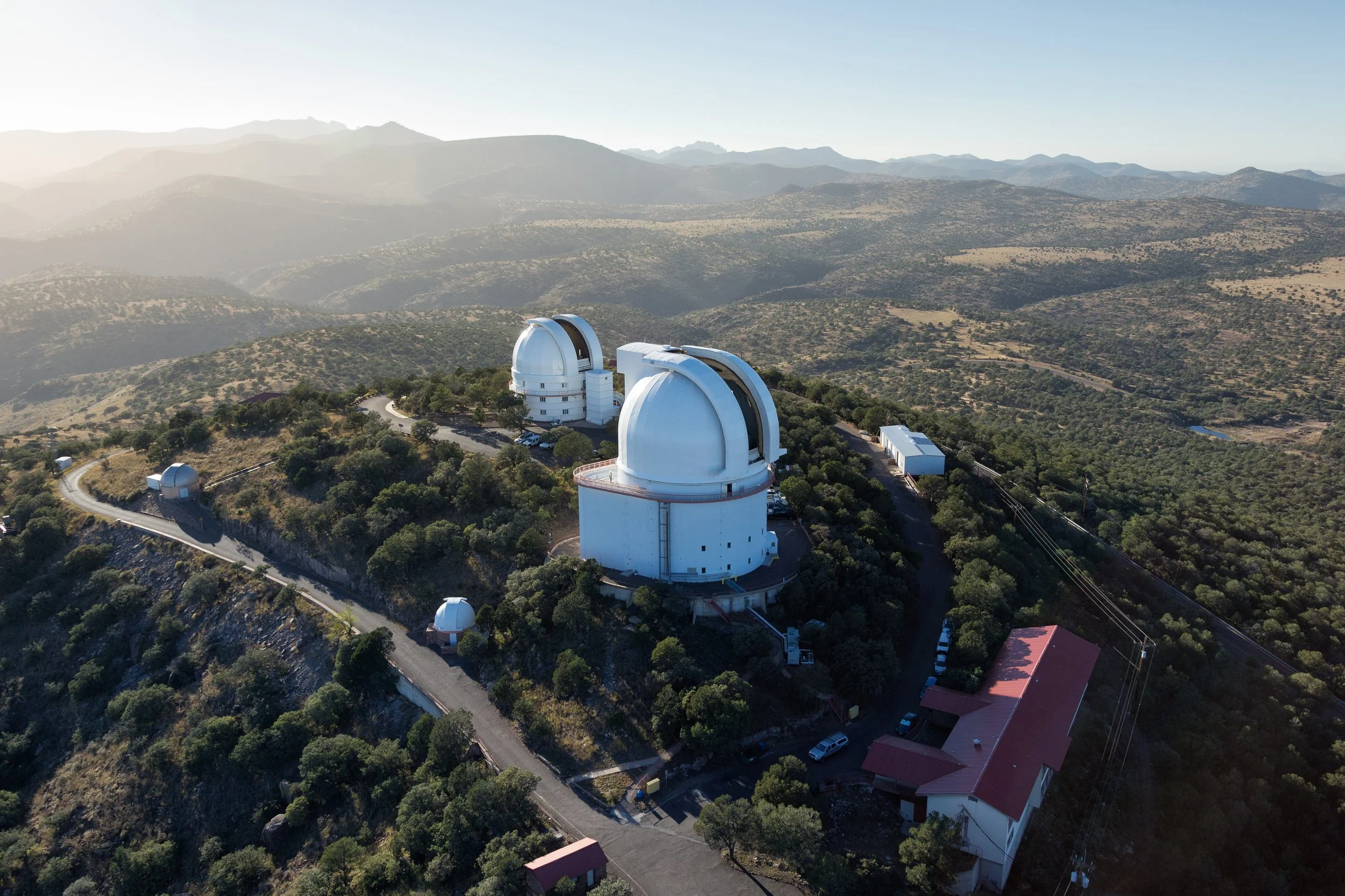
Image source: McDonald Observatory
May Skies: Meteor Showers to Mountain Observatories
How can it possibly be May already? Our planet is almost one-fourth of its journey around the sun; summer will be here before we even blink. Perhaps you are already planning summer trips. Our state’s famous McDonald Observatory should be part of anyone’s trips on vacation. The truly dark skies allow one to see what we are missing in our area’s over-lit skies. The scenery along the drive in the mountains is glorious.
McDonald Observatory - Special Viewing Nights will provide the curious opportunities there through the year; Although it is not deep in the heart of Texas, the observatory is definitely in the darkest region of the state. Teachers are offered opportunities for visiting and learning and spend several nights out there to experience how observing is done by professional astronomers. On a good night you might even be able to read the newspaper by starlight because the state has protected that area from lights shining up into the sky and the work at the observatories can continue its work. There is on-going work using a laser as well. A beam is sent to the reflectors that astronauts from Apollo missions 11, 14 and 15 placed on the moon to reflectors left on the lunar surface. The length of time that passes before the beam returns to its origin measures the distance our natural satellite. Their website provides interesting details of the work. (Link) If you visit, check out whether you are able to read by the starlight. And the Moon will be 257,177 miles away from Earth on the 4th.
We who are held on earth will be able to watch Jupiter and Venus and their progress around the Sun. Look in the west for bright Venus; Jupiter will be high in the south. Venus will become brighter during the month and gradually move in front of the stars in the constellation Gemini by the 19th. A good telescope and clear skies would reveal Venus in the gibbous phase near twilight.
Jupiter will be visible until 1 A. M. during the first half of May, then until midnight during the latter weeks. I never cease to be amazed that people are able to give the times we can see particular objects in space and have spacecraft land within a mile of where scientists assigned them to land. And it all begins with kindergarten math concepts. If you are an avid sky watcher you probably would enjoy watching Juiter’s moon Callisto transit across the face of Jupiter at 9:30 our time on May 6th. It will take about an hour to complete this transit. On Monday Io will transit at 10:56. If you are wondering about Saturn, it will be in the east just before dawn, low along the horizon with Mars.
Constellations to seek when the skies are clear include Gemini sinking in the west throughout the month. If you spot Jupiter, you will likely be able to see Pollux and Castor just above Jupiter. The meandering stars of Hydra stretch from due west to almost south. The pattern resembles the serpentine shadow cast by the sunrise on the first day of spring down the steps of the famous pyramid in Mexico. https://earthsky.org/constellations/hydra-the-water-snake-largest-constellation/
Hovering above Hydra are two constellations, Crater, the cup/chalice, and Corvus the Crow. Crater’s star pattern resembles a crab with outstretch pinchers while Corvus just looks like a slightly bent out of shape square. These three constellations are below the ecliptic (the path of our sun). This YouTube link will reveal other occupants of Hydra.
Sunday is the peak of the Aquariid meteor shower. Of course we may be blocked from this meteor shower too, with cloud cover. However, IF it should be clear astronomers suggest a site far from city lights because the Moon will be waning gibbous and that is problematic. The predicted shower is under a dozen per hour after 2:00 AM and it is strongly suggested to have best ‘seeing’ at 5:45 AM. Working does interfere with those who like to watch meteor showers though. Just keep in mind, Earth will be in the stream until the end of the month and stray meteors are really fun to glimpse as well and Aquarius rises about 5:00 AM and will not be very high in the sky, and this is important because those meteors appear to emerge from that constellation.
Until next time, KLU. And email comments or questions to carolutsinger@att.net.
