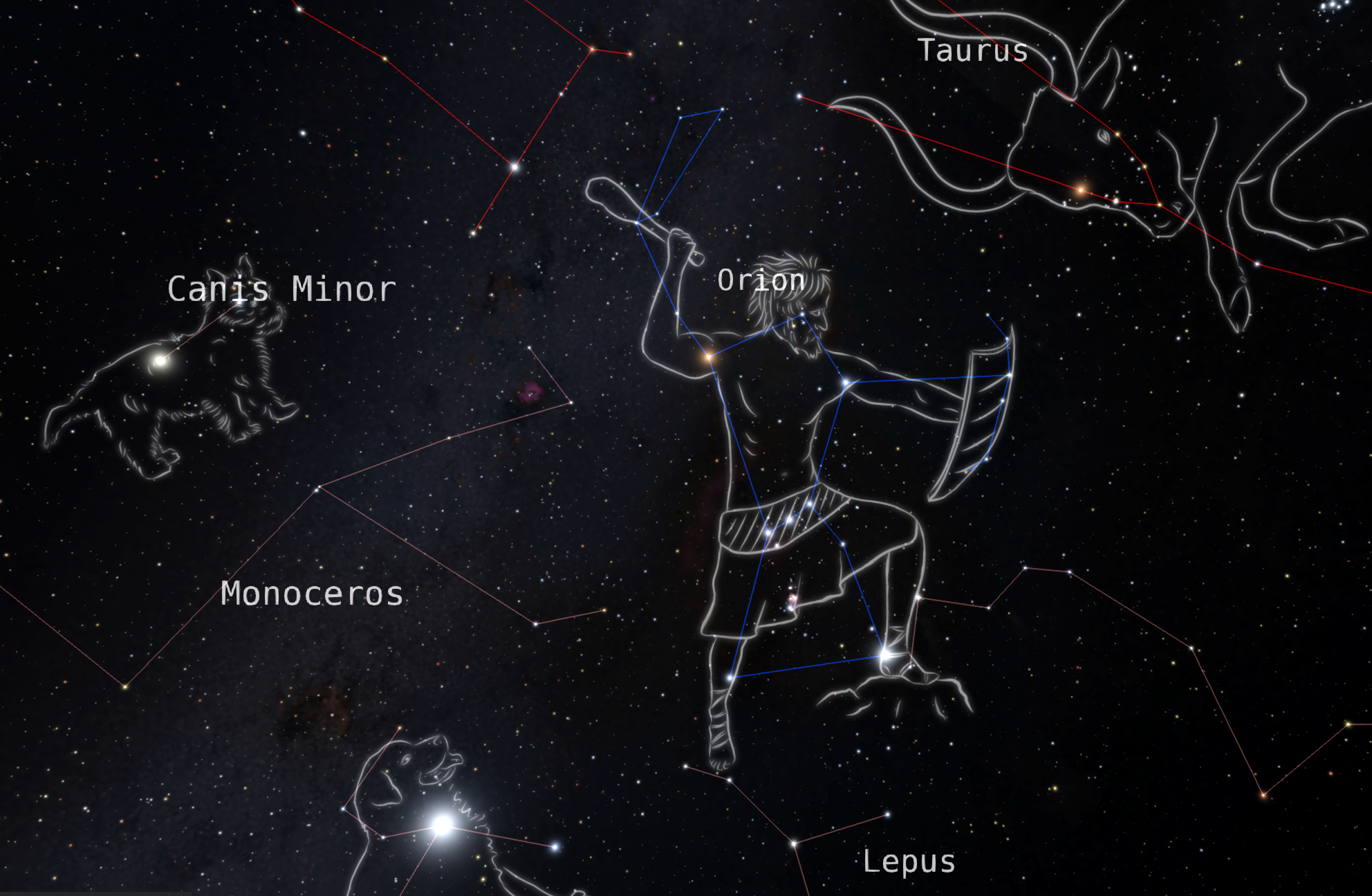
Image: OpenSpace
If the weather conditions permit at some point while Orion is in a good position to be explored with a decent telescope, grab your telescope and head outdoors to your favorite viewing location. Orion is a massive and easily recognized constellation and the perfect spot to add some treasures to your observing list. If you don’t actually have a list, it might be time to begin one. Birders have lists; why shouldn’t stargazers?
To begin with, there are several versions of how the constellation got into the sky, including a South Texas one with a Texas twang to it that your might find if you visit the South Texas Astronomical Society’s website. The Greeks and Romans had the familiar ones, but not the only ones. The South Sea Māori, the Egyptians, Babylonians, Japanese, Indigenous people of the Americas and Australia all had wonderful versions of who and why that cluster of stars that resembles a girl’s hair bow came to be there in the first place.
On a clear dark night set up your telescope in time to adapt to the humidity and explore. The Great Orion Nebula, the Horsehead Nebula and Orion’s Belt are probably each familiar to a regular star gazer. How about the Witch Head Nebula? Do you know the names of those brilliant stars of the belt? Don’t know or care? Would like to know more?
Alnitak, Alnilam, and Mintaka are all names of Babylonian/Arabic origin and describe the entire belt as “string of pearls,” “the line,” or the “girdle/belt.” The first star on the left is actually three stars, but one name. The three stars of Alnitak are massive, ranging between 30 times the mass of the Sun to 15 times the mass. That means the brightness is as much as 250,000 times of the Sun. Thankfully they are very far away, otherwise there would be no us. Mintaka is a system of five stars, each one larger than our Sun.
From a really dark site, the Orion Nebula appears as a fuzzy smudge of light in the sword that is suspended from Orion’s Belt. Over 1,300 light-years away, it is a stellar nursery, 25 light-years wide. Hundreds of thousands of hot young stars are forming in this region, whirling and pulling gasses into themselves to slowly accrue enough mass to ignite and become a protostar and after a long passage of time expanding to become a red dwarf, red giant, blue giant, or medium yellow ‘ordinary’ star like our sun.
The Flame Nebula and the Horsehead Nebula are located near Alnitak. Both are stellar nurseries of thousands of forming stars. There is so much to see in this one constellation it would give a patient person plenty to observe.
The peak of the Leonid meteor shower is the night of November16 and 17, appearing to come from Leo the Lion. Since the Moon is at first quarter it will have less of an effect on sky darkness-IF the sky is clear of course. Expect no more than a dozen per hour, and faint.
Figuring out which point of light is a planet and which ones are stars, the planets don't twinkle and stars do. After midnight Jupiter and Mars will be aligning in the east. Just at dawn Venus and Mercury may be visible to a knowing observer low in the east. Good luck.
Astronomers estimate our Milky Way Galaxy is 100,000 light years from one side to the other and that it is only one of billions of galaxies in the Universe. It is estimated there are more than a hundred billion stars in this one galaxy. When we think of the stars as being countless, and yet the estimate is using numbers for our national budget accounts, it is a little bit disconcerting. But it sure is a beautiful sight to stand out in the darkness and let your eyes become dark-adapted and see those points of light and recognize a familiar point of light.
Until next week, DO let some stars get in your eyes and KLU. carolutsinger@att.net