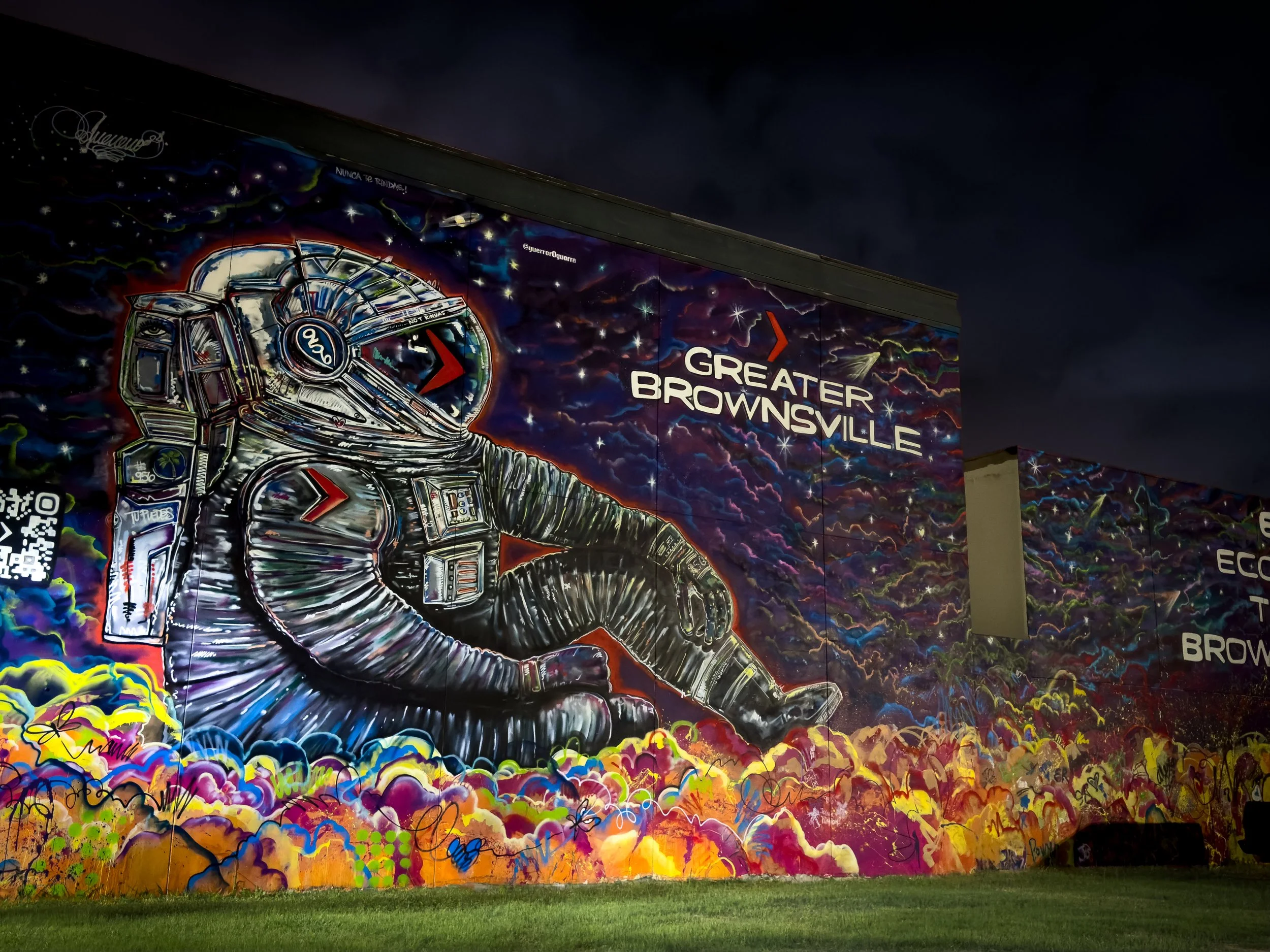
A space-themed mural featuring an astronaut adorns a building in Brownsville, Texas, highlighting the city's growing association with space exploration and the aerospace industry.
Mykel Del Angel | The Cosmic Current Photos
Ever since SpaceX began launching rockets from Boca Chica Beach, Brownsville has taken on a new identity: a space city.
City officials speak of aerospace, innovation and the future of Brownsville, but are we actually building a space city, or are we simply learning how to market one?
Putting rockets on posters and painting space-related murals is not enough to make Brownsville a space city. That identity should be reflected in the opportunities available to the people who live here.
Brownsville ISD students once held greater access to STEM-focused competitions through programs such as Science Fair, the Technology Student Association and SkillsUSA, but in recent years, funding limitations have increasingly restricted participation in these opportunities.
During my time at Pace Early College High School, I witnessed groups of around 40 students advance to state competitions such as Science Fair, SkillsUSA and Technology Student Association conferences. Funding limitations later capped participation in these activities at 20 students per chapter, and district-supported advancement was further limited to first- and second-place finishers, leaving some students who otherwise qualified unable to compete at the next level.
We cannot continuously market Brownsville as a growing center for space, technology and innovation while opportunities for students interested in pursuing those fields become increasingly restricted.
A real space city creates a culture around science by giving students meaningful opportunities to explore astronomy, aerospace and other STEM fields, supporting educators and organizations making those opportunities accessible and creating public spaces where people can experience astronomy firsthand.
I attended Brownsville’s Space Fest not long ago, and while the addition of a Maker Faire expanded its STEM programming, much of the festival still centered on rockets and SpaceX, with little emphasis on astronomy or space education. I walked away wondering what Brownsville believes a "space city" should look like.
Engineering and aerospace are undeniably part of space exploration, but they are not the entirety of it.
Where were conversations about astronomy, physics and the research being conducted at our local university? Where was sustained investment in public science education?
More importantly, where are those opportunities after tents come down, vendors leave and festival banners disappear?
Space already exists here in the students discovering engineering, astrophotographers capturing distant galaxies, educators making STEM accessible and volunteers setting up telescopes so strangers can see Saturn.
Those things may not make for flashy tourism campaigns, but they create something much more important: a community genuinely connected to science.
Becoming a space city comes with another responsibility; space exploration does not exist separately from the communities where it happens.
Progress should require us to ask who benefits from it, who gets to participate in it and what we are willing to sacrifice in its name.
Welcoming a commercial space industry does not require surrendering our own identity to it. Celebrating rocket launches does not mean we stop asking questions about their effects on our environment or community. Supporting space exploration should never mean that criticism, accountability or stewardship become incompatible with being "pro-space."
I have seen what happens when people stop waiting for someone else to create those opportunities: Launchpad brought students from across the Rio Grande Valley together to design and build Project Vortex, sending it 8,300 feet into the sky, while volunteers haul telescopes across the Valley to give the public opportunities to experience astronomy for themselves.
If Brownsville wants to call itself a space city, we should expect this title to mean opportunities, public astronomy, environmental stewardship and accountability.
A rocket on a poster is easy, but building a generation of people who understand, explore and care about the universe is harder.
Brownsville becomes a space city when the people who live here have an open opportunity to participate in space, question it, explore it and shape what it means for our community.