From student researcher to NASA principal investigator
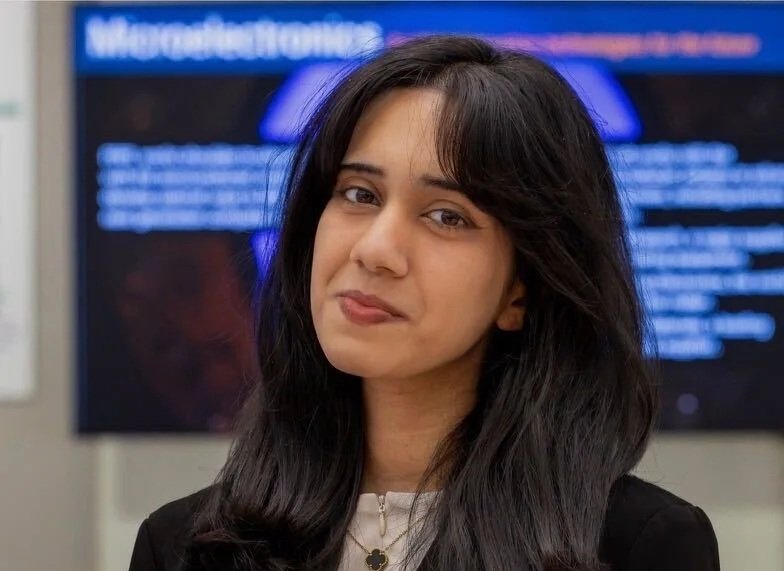
PHOTO COURTESY RISHIKA PORANDLA
On the Moon, even dust presents a scientific challenge. Fine particles covering the lunar surface can become electrically charged and rise above the ground, potentially affecting equipment and future exploration missions.
Princeton University junior Rishika Porandla is investigating this phenomenon as the principal investigator of LUNA-CAST, a NASA-funded experiment studying electrostatic behavior of lunar dust.
Her project was selected through NASA's L'SPACE Proposal Writing and Evaluation Experience (NPWEE), which brought together nearly 300 students and early-career participants. Her team received $10,000 in seed funding for a 12-month implementation and testing campaign at NASA's Marshall Space Flight Center.
For Porandla, becoming a principal investigator was not originally part of the plan.
"I didn't come in thinking that I was going to be a PI," she said. "It was much more incremental than that."
From student to researcher
Porandla's interest in astronomy developed in high school through NASA's STEM Enhancement in Earth Science program at the University of Texas at Austin. There, she used Python to analyze radio observations of distant galaxies.
Although she initially focused on computational astronomy, she became increasingly interested in instruments responsible for collecting scientific data.
"I enjoyed computational astro, but I realized that I was increasingly interested in the question of how we actually build the instruments that produce the data that we're analyzing," she said.
At Princeton, Porandla joined the Space Physics Laboratory, gaining experience in instrument design and engineering. She later conducted research at the Princeton Plasma Physics Laboratory, studying charged-particle instrumentation.
These experiences helped establish the scientific foundation for LUNA-CAST, which investigates how electrostatic forces can cause lunar dust particles to move above the Moon's surface.
Taking the lead
Porandla's transition into research leadership began through NASA's L'SPACE Mission Concept Academy, where she managed a team of nearly 20 students developing a concept for a Mars rover designed to explore subsurface caves.
As project manager, she coordinated scientific and engineering work while balancing technical requirements, scheduling and project constraints.
She later entered NPWEE, where participants developed original research proposals using NASA's mission-design framework. Of the 32 proposals submitted, LUNA-CAST was selected for funding.
Porandla emphasized that developing a successful proposal required more than identifying an interesting scientific question.
"A big thing is feasibility. Can you actually execute your proposal?"
For LUNA-CAST, that meant identifying measurable variables, selecting appropriate instruments and developing a realistic timeline for experimental testing.
As principal investigator, Porandla now coordinates experimental planning, team responsibilities and technical discussions with researchers and engineers at NASA Marshall and the University of Colorado Boulder's Laboratory for Atmospheric and Space Physics.
The experience has allowed her to apply both her scientific knowledge and the leadership skills she developed through earlier research opportunities.
Building connections
Collaboration also played an important role in developing LUNA-CAST.
Porandla's team consulted approximately 20 scientists specializing in lunar dust, plasma physics and lunar environmental sensing. Rather than simply requesting mentorship, they presented their preliminary research and asked specific questions about improving the experiment.
"And that changes the conversation completely, because now you're talking scientist to scientist," she said.
Porandla encouraged aspiring researchers to approach scientists through shared interests and thoughtful questions instead of focusing exclusively on prestigious institutions.
She also emphasized mentorship does not necessarily require joining a laboratory. Students can benefit from feedback on independent projects, discussions about scientific questions and recommendations for further research.
For students interested in pursuing research, Porandla advised gaining practical experience rather than waiting until they have mastered every technical skill.
"Every skill kind of came from a project that required it," she said.
As LUNA-CAST moves toward experimental testing at NASA Marshall, Porandla's journey reflects how research experience, collaboration and initiative can lead to opportunities beyond a student's original expectations.