From the RGV to the cosmos: listening to cosmic ripples
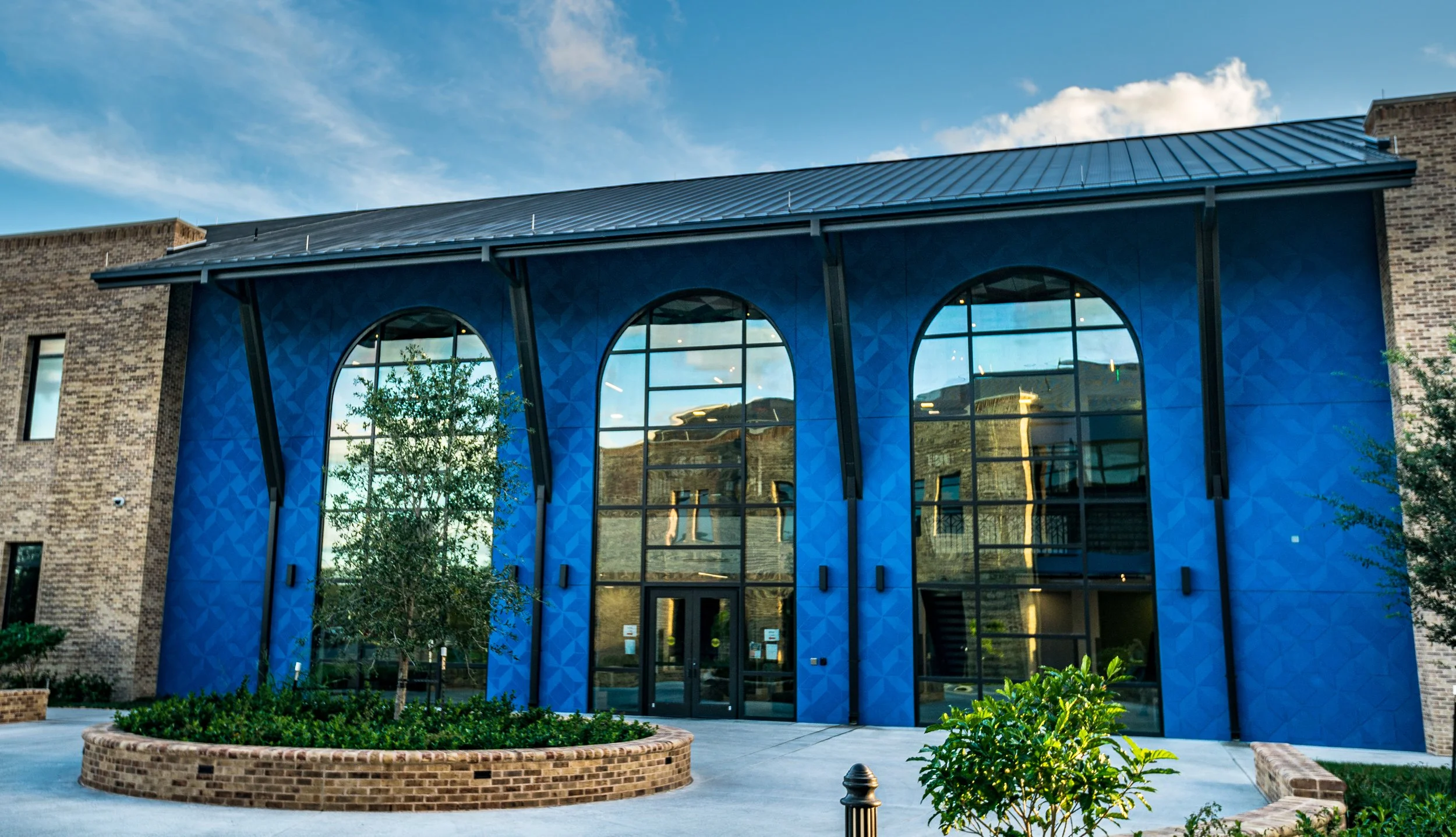
PHOTO COURTESY UTRGV/DAVID PIKE
Brownsville isn’t just a city on the border; it’s a city on the frontier of the cosmos. At UTRGV’s Brownsville campus, researchers listen for gravitational waves, cosmic ripples in time created by massive astrophysical events, which can tell us about black holes, neutron stars and perhaps what happened in the early universe, before light could emerge.
Before the first detection
Researching gravitational waves in the 1990s was difficult since astrophysicists did not have technology to detect them.
"Most physicists and pretty much all astronomers felt that the endeavor was futile. Not only was there resistance among the astronomical community, many physicists themselves were skeptical that the level of precision to detect gravitational waves was ever going to be reached,” said Mario Diaz, professor of physics and astronomy at UTRGV.
Despite having limited technology, the physics program at University of Texas Brownsville (UTB), now UTRGV, looked toward the future.
Díaz and his students began writing programs and algorithms which could analyze data and process signals before gravitational-wave detectors were ever built. Today, they also design optics and instrumentation that help reduce noise in the detectors, including by mitigating the effects of heat generated by the infrared laser beams used in observatories.
Rather than waiting for detectors, such as the Laser Interferometer Gravitational-wave Observatory (LIGO) in the United States, Virgo in Italy and the Kamioka Gravitational Wave Detector (KAGRA) in Japan, to be built, Díaz said the university joined a larger effort to write software which would be used to search and analyze the data once massive detectors were operational.
“There was no data. But our group was part of a much larger effort to write the software that will be used to analyze and search in the detector data once they come online," Diaz said.
As gravitational-wave research developed, so did the program in Brownsville. UTB received several grants and awards from NASA and the National Science Foundation (NSF), helping expand instrumental research in the Department of Physics and Astronomy. In 2003, the university established the Center for Gravitational Wave Astronomy and recruited additional experimental physicists.
Following the creation of UTRGV, this work continued through the university. It was later brought under the South Texas Space Science Institute (STSSI), which united the Center for Gravitational Wave Astronomy (CGWA), the Center for Advanced Radio Astronomy (CARA) and other space-related research efforts across the university.
Today, researchers at STSSI continue looking for different kinds of gravitational-wave signals. Joe Romano, professor of physics and astronomy and director of STSSI, studies what is known as the stochastic gravitational-wave background, overlapping signals from many independent sources that reach detectors at the same time.
“It could be the combined signal produced by hundreds of thousands of pairs of supermassive black holes orbiting one another in the centers of merging galaxies, occurring throughout cosmic time,” Romano said.
Romano, his students and colleagues are working to detect the extremely small distortions in spacetime that could reveal this background.
“One way of doing that is to use very sensitive large-scale laser interferometers, like LIGO,” Romano said.
But gravitational waves are only one way researchers can observe these cosmic events.
TOROS International Observatory
Beginning in late 2009, the LIGO and Virgo collaborations began working with astronomers to search for electromagnetic counterparts to gravitational-wave candidates, using observations in wavelengths including visible light and X-rays.
Researchers expected some events capable of producing gravitational waves, such as neutron-star mergers and supernovae, could also produce detectable electromagnetic signals.
Combining these different sources of information is known as multimessenger astronomy. The four messengers astronomers study are electromagnetic radiation, cosmic rays, neutrinos and gravitational waves.
As interest in multimessenger astronomy grew, Díaz worked with other researchers to identify a site for an observatory that could expand the university’s astronomical research.
In 2013, Díaz partnered with Diego García Lambas of the University of Córdoba in Argentina and Lucas Macri of Texas A&M University to develop the Transient Optical Robotic Observatory of the South (TOROS). The team selected a site at El Leoncito National Park, west of San Juan, Argentina.
Díaz said TOROS will help train the next generation of “big data” astronomers from diverse communities across the Rio Grande Valley, elsewhere in Texas and Argentina.
According to a research paper published in the Astrophysical Journal Letters, the TOROS collaboration was a significant contributor to the first gravitational wave detection correlated with any electromagnetic observation
UTRGV as a leader in research and development
UTRGV’s South Texas Space Science Institute is an important contributor to the field of gravitational wave research and the development of local students evidenced by the fact several UTRGV professors were honored with the Special Breakthrough Prize in 2016. In addition, Díaz received the Leopoldo Garcia-Colin Medal from El Colegio Nacional in Mexico City in 2020 for his support of Latin American students.
The UTRGV physics professors in Brownsville have published hundreds of papers and several books, including Díaz’s “The Sounds of the Cosmos,” co-written with Louisiana State University professors Gabriela González, who served as LIGO spokesperson when the first gravitational wave was detected in 2015, and Jorge Pullin, whose research includes black holes and quantum gravity.
Their work in student development and mentorship has also contributed to former students pursuing careers as professors and researchers. Together, these efforts have established UTRGV as an active center for gravitational-wave research while creating opportunities for South Texas students to participate in the field. What started as a handful of researchers in Brownsville has grown into a pipeline: one that now sends RGV students into the same field that’s rewriting what we know about the universe.