Texas-built spacecraft to carry JPL drones to the Moon
Firefly Aerospace will deliver four drones to the Moon’s south pole as part of NASA mission.
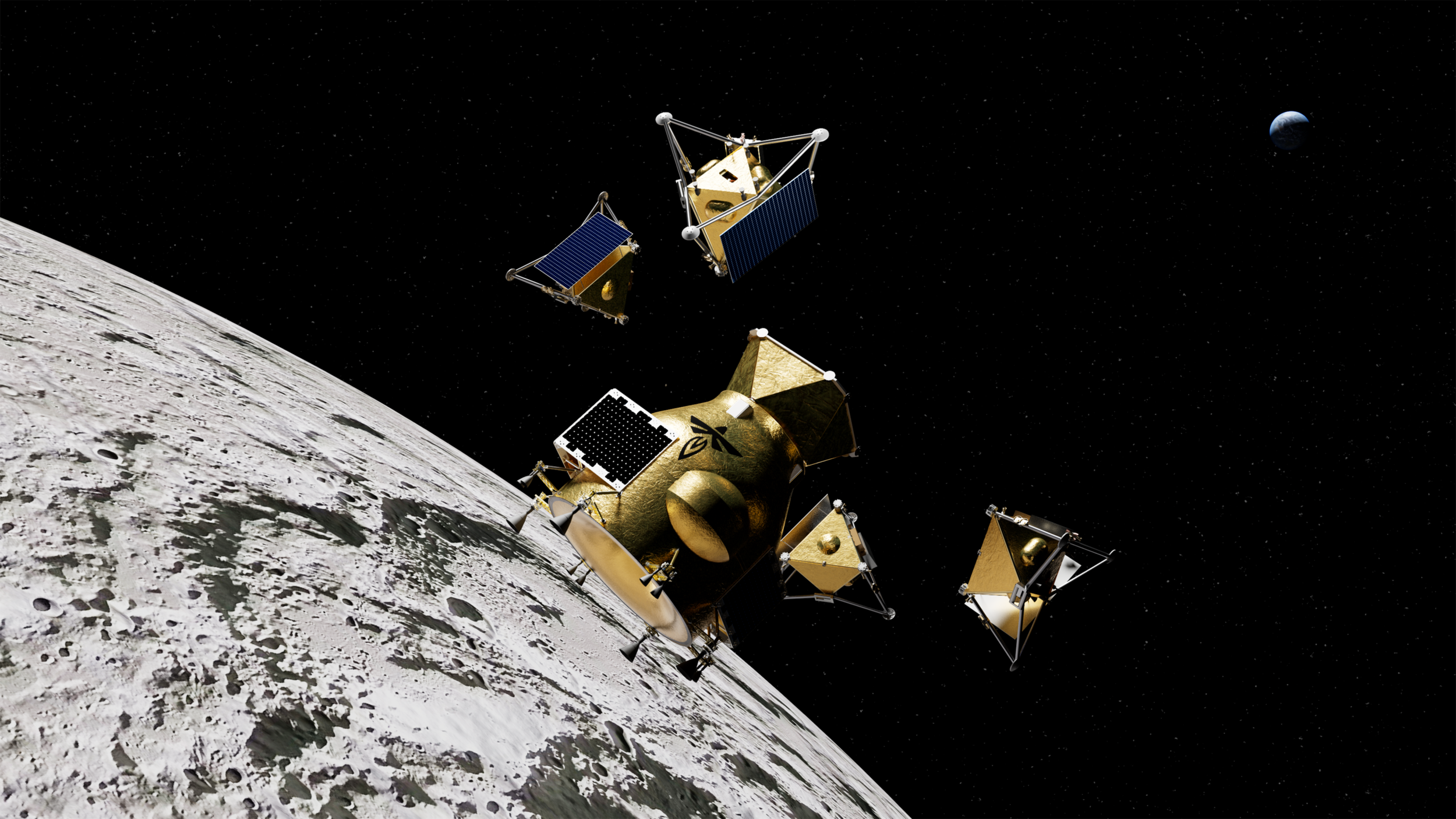
IMAGE COURTESY FIREFLY AEROSPACE
Firefly Aerospace is building a spacecraft to deliver four NASA drones to the Moon's south pole in search for water ice beneath the lunar surface.
On May 26, NASA announced the mission as part of MoonFall, an initiative to prepare for future human operations and a permanent lunar base.
MoonFall is part of an initial phase of NASA missions to scout, experiment and prepare for human surface operations on the Moon, leading to the eventual construction of a permanent lunar base, according to JPL.
The company successfully landed the Blue Ghost spacecraft on the Moon on March 2, 2025, and is preparing for a second Moon mission led by Blue Ghost II, planned for late 2026. Firefly will transport the JPL-built drones aboard the Elytra spacecraft. NASA has yet to announce the source of the launch vehicle.
Elytra will launch from Cape Canaveral, Florida aboard a rocket carrying the four JPL drones. After launch, the spacecraft will separate from the rocket and transport its drone payload to the Moon during a 45-day journey before entering lunar orbit. Upon reaching the Moon, the spacecraft will perform a braking maneuver to deploy drones one-by-one approximately 50 kilometers (31 miles) above the lunar south pole.
According to JPL, the drones will land on the Moon “individually and operate independently, using up to 10 high-definition optical cameras to acquire high-resolution imagery and video of hard-to-reach terrain.”
Each drone will have its own propulsion system which allows for multiple flights over the surface to capture images, videos, and digital terrain maps “at significantly higher resolution than current satellite imagery”.
They will determine the abundance of subsurface water using a neutron spectrometer system. All this over a single lunar day, approximately 14 days on Earth.
As lunar night falls, temperatures drop below minus 208 degrees Fahrenheit (minus 133 Celsius), freezing any remaining propellant.
The drones are equipped with "survive-the-night" technology that allows them to reactivate once exposed to sunlight, enabling additional science experiments over several months.
Carlos García-Galán, NASA program executive for Moon Base, said the agency has ambitious plans for the Moon base.
"We envision the moon base to be hundreds of square miles, with different assets all building up to the objective of permanent lunar presence on the moon."
Elytra's role is to deliver the drones so they can determine how much water ice exists within craters and beneath the lunar south pole.
Water ice could provide drinking water, water for cooking and hygiene, and support life-support systems. It also can be split into hydrogen and oxygen through electrolysis to produce rocket fuel.
These findings make the lunar south pole the most strategic location on the Moon for future missions, bases, and other endeavors.
Texas colleges and universities offer astronomy, engineering and aerospace programs that support the state's growing space industry, including the University of Texas at Austin’s’ Department of Astornomy and UTRGV’s Center for Gravitational Wave Astronomy.
Many engineers, programmers, machinists, and technicians who make missions like MoonFall possible are Texans who learned their skills from programs at schools which support the space industry.