
Image source: Star Walk
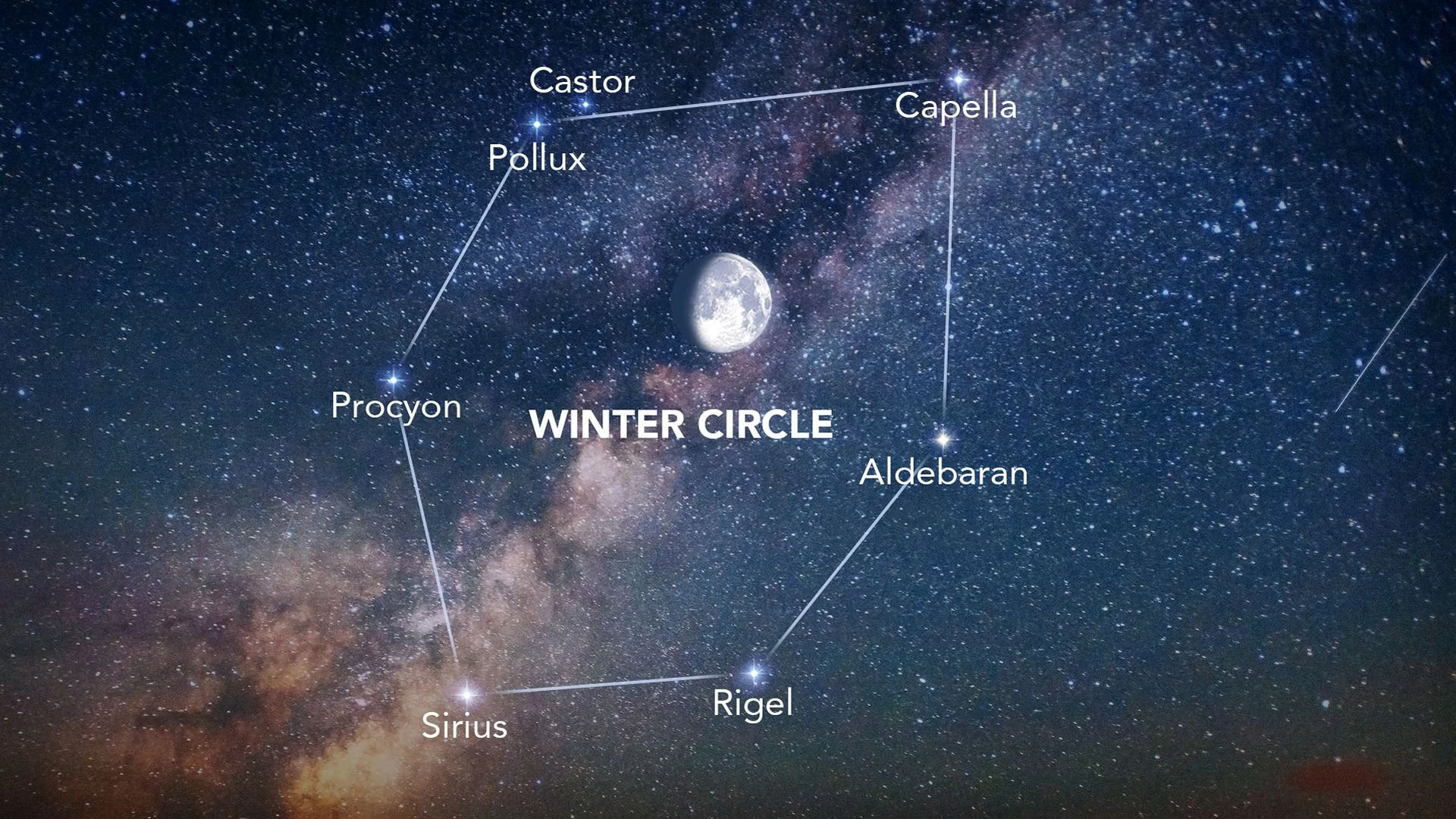
The Winter Circle
Happy New Year with all that signifies to us as we hang up the new calendar and write in those special dates of family and friends’ birthdays and anniversaries. I am sure of one thing, 2026 will once again take Earth through its orbital path and bring the regular constellations into view. Don’t be like the king in Bartholmew Higgins and Oobleck.
In recognition of these things that we count on to be there when they always are, here are some of the regular asterisms to enjoy in the dark of night through March. The largest is known as the Winter Circle, or Winter Hexagon, formed by seven stars that dominate the northern winter sky. These are Rigel in Orion, Aldebaran in Taurus, Capella in Auriga, Castor and Pollux in Gemini, Procyon in Canis Minor, and Sirius in Canis Major constellations. Sirius and Procyon are also part of the Winter Triangle, a smaller asterism that these two stars form with Betelgeuse in Orion.
The Winter Hexagon can be seen high in the sky between December and March in the northern hemisphere, with a band of the Milky Way running through the center of the asterism. Unless your viewing site is away from light pollution you will not be able to see the Milky Way since the stars are faint and overcome by the glare of nearby suburbs and cities which wash out the view. The following site has some images of the constellations that comprise the asterisms mentioned: https://www.constellation-guide.com/winter-hexagon/ There are links to share detailed information about the constellations and their component stars which might keep you online for quite a while.
I WOULD like to invite you to bring the family to the weekend star party out at Rocket Ranch. I bumped into the owner recently, asked him and his friends if they would like to hold some meteorites. One thing led to another and we STARS were invited to have a star party there. Of course, I said YES for the opportunity and so on January 10, from 7-9 PM there will be constellation stories, making and using a star wheel, and telescope viewing at Rocket Ranch way out on Boca Chica Highway heading to Starbase. WOW. And I will even bring those meteorites for you to hold. And it is FREE. [Update: Due to weather and cloud coverage blocking visibility, this event will be POSTPONED to a later date.]
The story of STARS per se is one I marvel at all the time. The newspaper has been kind enough to publish this column since 1998 and back in those days three of us were STARS, South Texas AstRonomical Society-a bold title for a mere three people who enjoyed sharing telescopes and a school district portable planetarium at the Brownsville Public Library. Over time our families’ needs and light pollution there meant no more STARS. That is, until a few years later when a young man took a hike through the Resaca De La Palma state park, noticed the Cristina Torres Observatory, and contacted the head of the physics and astronomy department at UTRGV and his excitement brought back STARS on steroids. Victor De Los Santos and Maki Jette and now many others, have grown the group beyond my wildest imaginings.
You may have attended other opportunities shared by the dozens of STARS volunteers and seen first-hand how the organization has progressed. If not, we look forward to seeing you soon at STARS at Rocket Ranch, 43742 Palmito Hill Rd, Brownsville, TX
Until next time, KLU and DO let some stars get in your eyes. Carol
