
Image source: Eric Kennedy
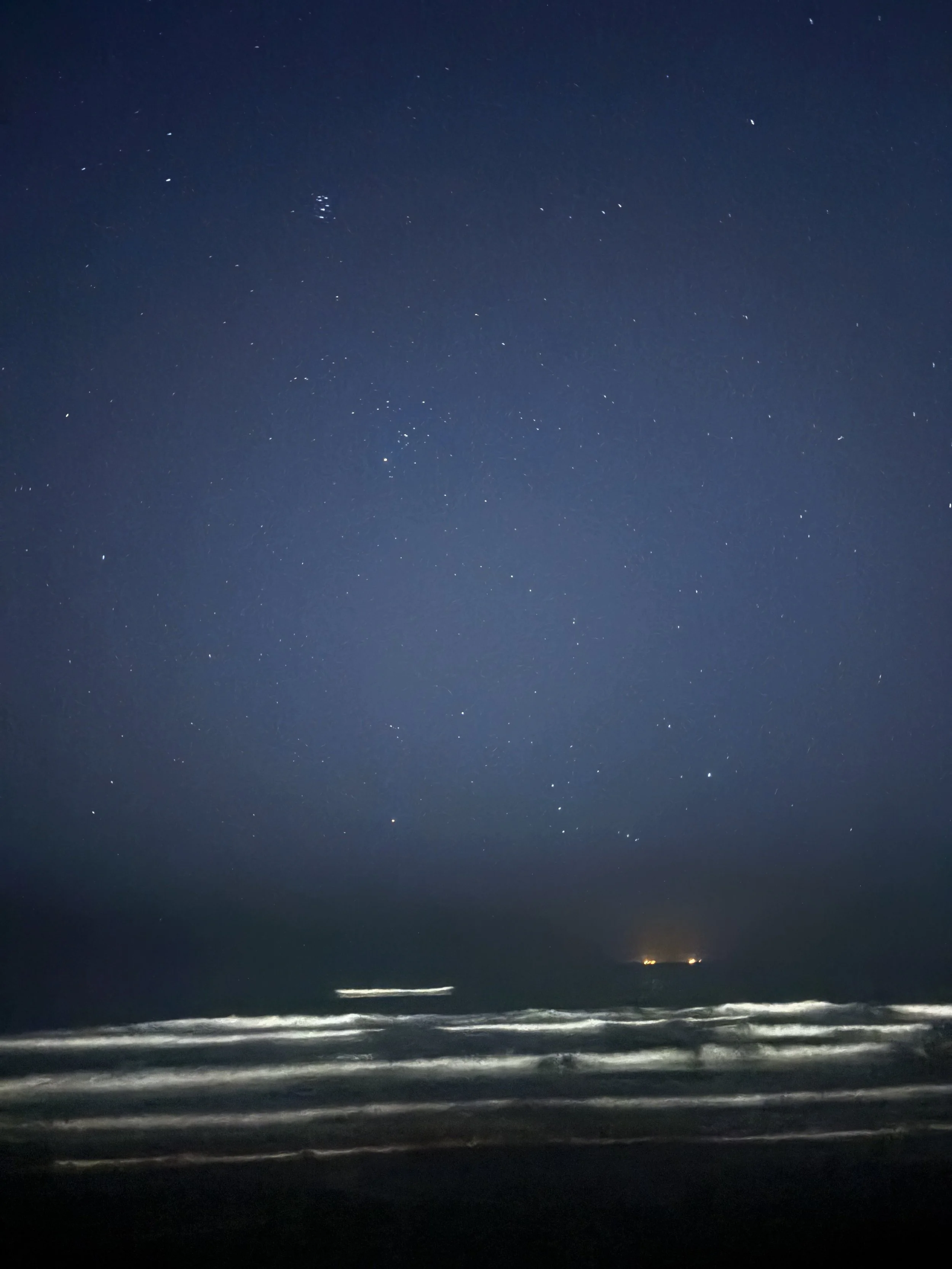
The Stars from South Padre Island
I was recently sent a photo of the eastern sky from Eric Kennedy, a member of the South Texas Astronomical Society, who graciously has made it possible for you to also see, in order to connect this week’s column and then go outside during the night and locate the same constellations from where you are, if the sky is not light-polluted. The lower edge of the photo is all Orion the Hunter. The photo is so sharp that we can even see that Orion has a very small head of stars, the tiny triangle above his shoulders. If you are outside with a good telescope take a good look for the Great Orion Nebula, M42. (https://apod.nasa.gov/apod/ap241104.html). Of course the colors will not be seen in the telescope view. Special filters allowing specific wavelengths of light are assigned colors which give those spectacular images online. What a difference technology makes for star gazers.
Above Orion is Taurus, the Bull with the tight cluster of stars named the Subaru by the ancient Japanese astronomers just above it. The Greeks called this cluster the Pleiades/Seven Sisters-we’ve mentioned these before. The V asterism of Taurus is called the Hyades. Its horns extend towards the left and are named Tianguan and Elnath. The brightest star in Taurus is a variable star named Aldebaran. It is actually in line of sight between Earth and the rest of the stars in the Hyades which makes it appear brighter but the others, even though the stars forming the V are 150 light years farther away. A variable star actually increases and decreases its brightness which has led to special studies of them. There is even a group of scientists called the American Association of Variable Star Observers (AAVSO) who focus on learning more about these intriguing stellar objects.
To the left of Orion are two stars which mark the feet of Castor and Pollux, the Gemini Twins. That constellation appeared to be the source for the many Geminid meteors so many of you saw a few weeks ago. These stars are probably Alhena and Tejat. I will not test you on that-I had to look it up.
To the right side of the image are a few stars of the River, Eridanus, one of the largest constellations that stretches across many degrees of sky and whose stars are very faint and difficult to see. The faint stars above the river are part of the tail of Cetus, the Sea Monster who had hoped to have Princess Andromeda for lunch one day.
When you go outside to see what you can see from your site, look straight overhead for the crooked V of faint stars delineating the hero Perseus, carrying the gruesome coiled snake-haired evil Medusa. Perseus was tasked with destroying her because anyone who looked at her was turned to stone. He used that trophy to turn Cetus to stone and rescue Andromeda and they married and lived happily ever after. Those Greek and Roman tales and myths are truly gruesome, but then so are many of Grimm’s tales. I wonder why we are intrigued by that even today?
I had a very happy encounter with the folks from Rocket Ranch the other day when I asked a group if they would like to hold some meteorites-and the result of that is they would like to host a star party out there on January 10 from 7:00 PM-9:00 PM. We plan to have constellation stories, put together and learn how to use a planisphere, and if the skies are clear do some first-class star-gazing. I am sure details will be found on the South Texas Astronomical Society’s FB page soon.
If you are an early riser, by 5:00 A. M., look for the Big Dipper to be "dumping" out the milk, followed by Boötes with its beautiful golden star Arcturus. There is also the constellations Hercules, and Leo, the Lion to all be showing off. The graceful curve of Corona Borealis can be seen located between the kite-shape of Boötes, and the keystones of Hercules. Auriga the Charioteer's pentagon of stars will be low in the west as the sun still lurks below the horizon, waiting to break forth with a blaze of splendor just a few minutes sooner each day now until June, and the first day of summer.
Until next weekend, DO let all those sky-based stars get in your eyes and KLU. And as always email is carolutsinger@att.net with questions or comments.
