
Image source: StarWalk
The Moon, Jupiter, & Orion’s Hunting Dog
I hope you made opportunity to look up this past week and noticed how the distance changed between the waning moon and Jupiter over the past few days. Of course, I also hope you caught the almost Full Moon on the 31st as it hung above the gas giant member of our Solar System. The clear dark sky made the Moon appear even more wonderful and then there was the small point of light gleaming about a fist-width below Jupiter. I never tire of experiencing those perfect opportunities to see our neighbors in the sky.
If you keep an eye on the sky and appreciate even the times when the sky is covered in clouds, then we are two of a kind. As the colors of the clouds at sunrise and sunset reveal the colors of the sunlight itself, then the class you took in elementary school or middle school related to prisms, gives those glowing colors more relevance I am sure. You might even have read the book Theodoric’s Rainbow which made you more appreciative of science as well-perhaps even inspired you to hang a prism in a window or on the rearview mirror in your vehicles.
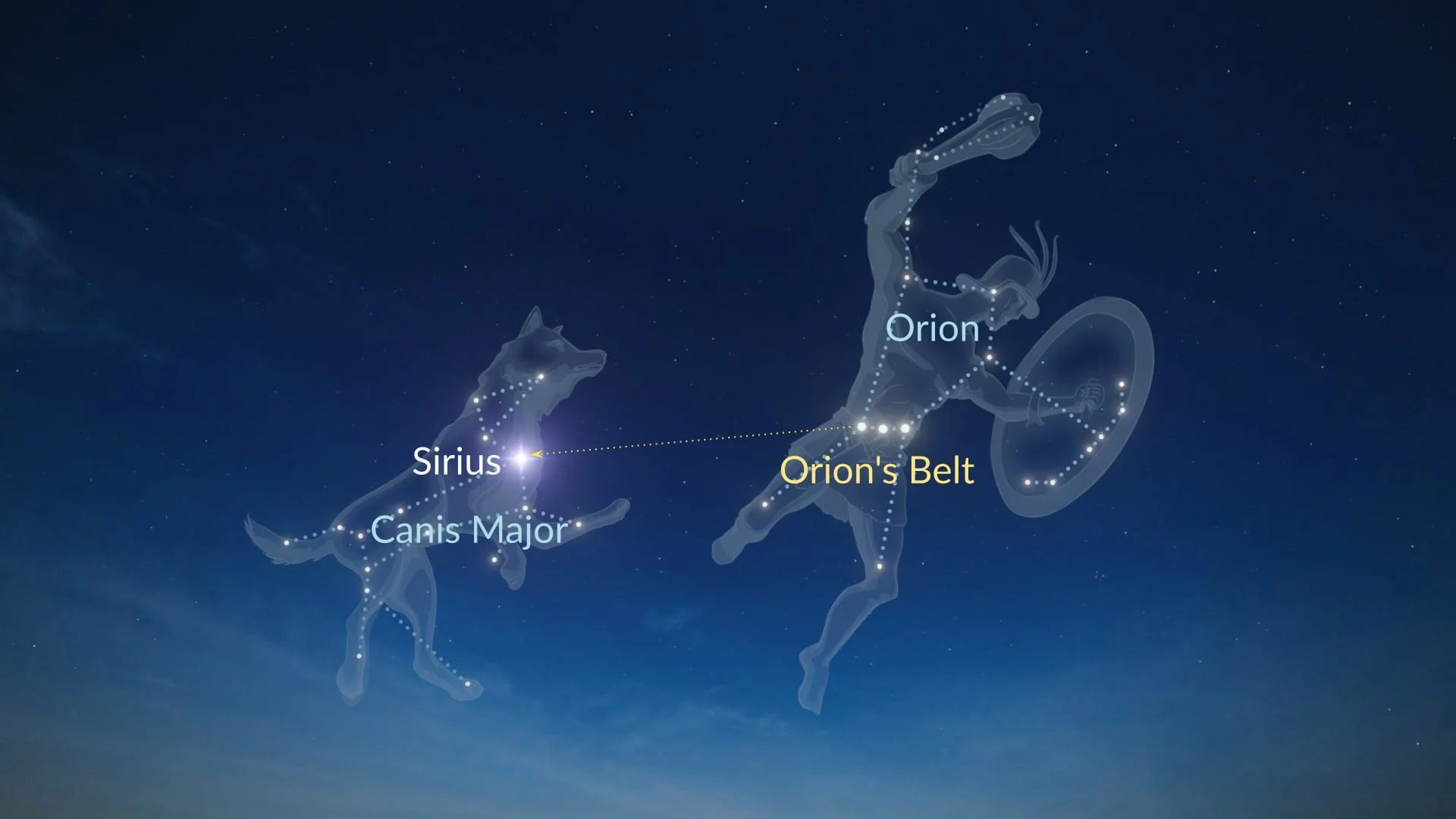
On the next clear night take a walk about nine o’clock and locate the constellation Orion high in the south. Directly overhead here in our latitude the pentagon of stars named Auriga, the Charioteer, or as one might imagine today the driver of the monster 4WD pickup truck, is just above Taurus, the Bull. The easier one to spot is Orion, with his three stars in a row WWE belt. We mention this constellation often because it is very unique in appearance and brightness of its main stars. It is a personal favorite because it was the first officially named constellation, other than the Big Dipper asterism, that I could identify.
If Valentine’s Day diamonds are on your mind, there is a blazingly beautiful star just to the lower left of Orion in his hunting dog’s collar. Oddly enough the dog is simply called Canis Major, yet the star is honored with the name Sirius. All the colors in white light sparkle from Sirius on a cold winter-early spring night. Against the black velvet of the sky, it is truly magnificent and would put a diamond to shame. I suspect this star is what put the idea in the jeweler’s mind to display those tantalizing rings and necklaces against black velvet and add bright lighting to catch a shopper’s eye and put a gleam in many eyes. Sirius is the brightest star seen from planet earth, classified as -1, and the brightness and magnitude of all other stars are categorized by it. The twinkling effect is because it is lower in the sky and its light is passing through more of our atmosphere which scatters the light, similar to one’s feet under shoreline water at the beach seem to ripple.
Near Sirius, slightly above is a faint star that marks Canis Minor, called Procyon; above and to the left of Procyon are Pollux and Castor, the Gemini Twins. If you are using binoculars or a telescope your field of view will include many stars in the lower Milky Way that crosses near the zenith and ends WNW, where Cygnus has sunk into the horizon by this time of evening.
Continuing on our serious discussion about Sirius, it is the closest star to us, aside from the one we continually orbit. It is almost nine light years away; in standard measurement, this is 53 trillion miles. Someone much brighter than I compared it this way: If the sun were the size of a ball, our planet would be a pin prick 13 feet away and Sirius would be a tennis ball 1400 miles away. I shudder to think about this when I connect it to our national debt. Yikes.
The ancient Egyptians called it the Nile Star and considered it a god they named Osiris. Its rising coincided with the annual flooding of the Nile River which made raising crops in Egypt easier, creating rich bottomland soil. It rises at dawn on the first day of summer. So much of what we do today connects with the past ‘because we always did it this way’ doesn’t seem odd at all.
We tend to think of stars as white-at least we depict them that way, but if you look carefully, you will be aware that Betelgeuse in Orion’s right shoulder (from your view) is decidedly red and so is the baleful eye of Taurus. Rigel in Orion’s right foot is definitely blue.
If this seems to be a lot of emphasis on color, it is a vital component of astronomical understanding. You might want to consider joining the South Texas Astronomical Society’s next informative session, A Cup of Cosmos, February 21 at Fly the Flag Coffee Shop in Brownsville from 4:00-6:30 PM. The only cost is what you order on your own.
Until next weekend, KLU
