
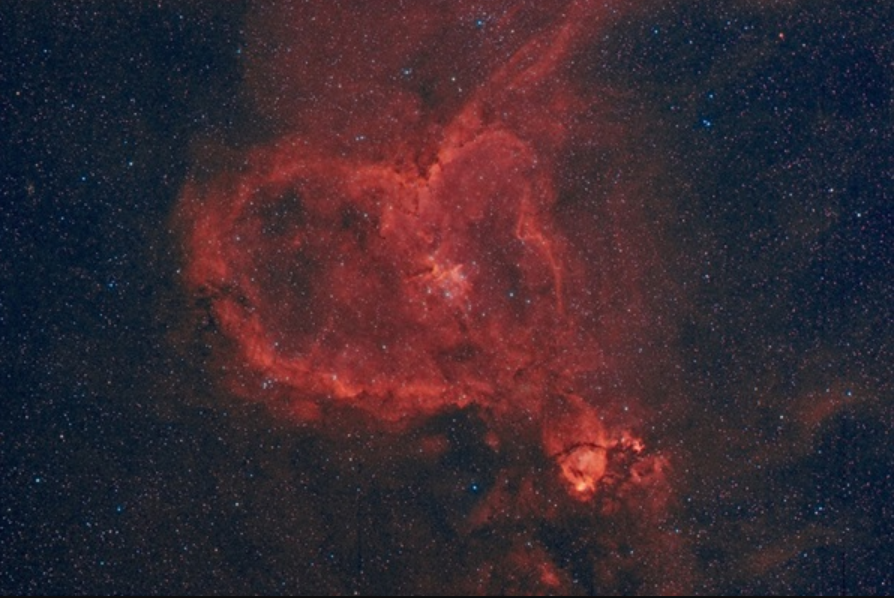
Image source: Astronomy Magazine
Valentine’s Day Stargazing
Happy Valentine’s Day — and if you didn’t have money to buy something sparkly for your Valentine, consider taking a walk and showing off the things that sparkle in the nighttime sky. You might even ‘give’ someone a star or constellation. Personal memories between a couple is always special and, after all, one cannot lose a star.
This month’s issue of Sky & Telescope gives those of us who live this far south a head’s up that the slender crescent Moon will cross in front of (occult) Mercury on Wednesday, the 18th, Look for the Moon low in the west within 45 minutes to an hour after sunset. Saturn and Venus will also be there to bracket Mercury. I will keep my fingers crossed that we have clear skies for this; it would be a great sight to capture with a good camera. The article states that in New Orleans the occultation will begin at 6:36 PM and disappear 15 seconds later. In case you want to try to glimpse the anticipated event, the International Occultation Timing Association (IOTA) has a site that will give exact times for our area. https://occultations.org/.
Another opportunity for exploring Jupiter will also give us something to do for Valentine’s Day. By full dark it will be well up in the east, crossing the meridian about 9:30 PM our time and be a good target until the wee hours of the morning. Jupiter is very bright, -2.6 and any steady-mounted telescope will expose the patterns of the clouds surrounding our gas giant solar system companion and the four Galilean moons. Binoculars will show at least two and possibly three of the moons. Both Astronomy and Sky & Telescope magazines have detailed charts and diagrams of the positions of the four biggest moons of Jupiter during each night of the month.
I learn a lot of things researching for the column to keep it up-dated from year to year. The same constellations appear year in and year out at the same times, but the phases of the Moon change, as do the positions of the planets in our solar system, which would lead to boring reprints for sure. One of my favorite stories as a fourth grader was the Russian folk tale, The Snow Maiden. Until I read this month’s S &T magazine I had no idea that this related to the V-shaped asterism marking the head of Taurus the Bull. In the 1800s a story about the Snow Maiden was written and Rimsky-Korsakov wrote music to tell the story. Slavic people called her Snegurochka, and she is a major player in Russian New Year’s celebrations.
I wish I had known then what I know now about astronomy. I am so thankful that many years ago our school district purchased a portable planetarium and my principal sent me to the training. It made such a difference in my life. If you have an opportunity to either encourage building a decent brick and mortar planetarium or a portable one to be shared at your school district, or take your family to a program at one, DO IT. You may be encouraging the next Carl Sagan or Vera Rubin. Although many Valley school districts have portable planetariums available, few schools use them. It always intrigued me that Mercedes ISD had a brick and mortar planetarium and the larger districts did not. Astronomy is the oldest science and one that leads to other sciences, chemistry, physics, archeology, geology, and even bringing new sciences to our attention, astrobiology, archeoastronomy, to mention just a few.
Constellations to enjoy include Taurus (Snegurochka) who was a doll created from snow by a Russian childless elderly couple who longed for a daughter. She always wanted to be out in the snow and joined a group of girls playing a game of leaping across a fire. When she jumped, the flames (Aldebaran, the red star marking the eye of Taurus) greeted her and she melted away in a white cloud. This brought spring back; when winter returned once again, so did the snow maiden to join her elderly parents for awhile before the cycle repeated itself. I am including a link to a far different version of the childish story I read and enjoyed. It will pull at your heartstrings I am sure. But keep in mind, it is a fantasy, and winter always comes, bringing spring again. https://fabulahub.com/en/story/legend-snow-maiden-snegurochka-original-folklore-version/sid-2685
Join the South Texas Astronomical Society on the 21st for conversations about space-flight related issues https://starsocietyrgv.org/events. And comments or questions for the column are welcome via email carolutsinger@att.net.
Until next weekend, KLU.
