
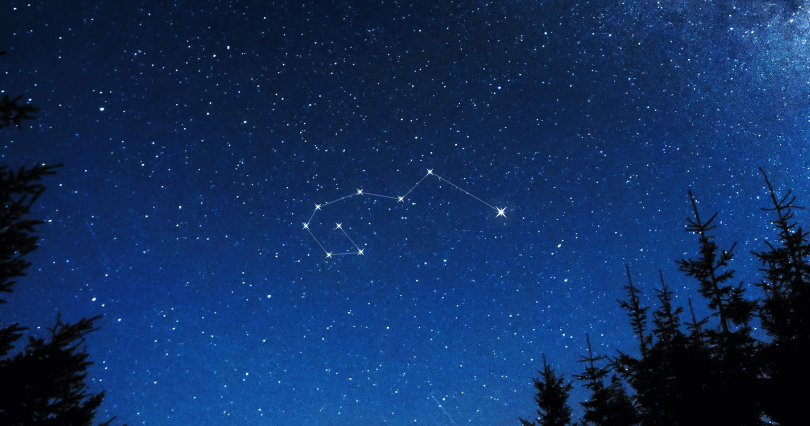
Image source: StarRegistration.net
Planets, Eclipse, & More Stars
Welcome back — it is nice to know you are reading the column and I appreciate hearing from you whether it is with an online comment or personal while out and about around town. Were you able to satisfy your curiosity about the lineup of planets this past week? That was not your only opportunity and with a keen eye and a clear western horizon and dark skies just after dusk an observer will find that Saturn will be very close to Venus, but very dim, just to the upper left of Venus. Keep in mind both planets will be very low, less than a fist width above the horizon this week. Saturn will soon be out of sight, but Venus will be rising higher in the sky each night. Neptune is there as well, but so faint and so far that even a large telescope would not reveal it. Those orbital paths make a difference for sure. If you are a teacher and would like an outdoor activity to help your students understand what is happening to cause this pattern I would be glad to share it with you.
Did you get up early to watch the lunar eclipse? Not knowing whether it will be cloudy or hazy or totally clear makes astronomy an iffy hobby, but when conditions are just right it is amazing to be out with friends observing the phenomena presented continually for our viewing pleasure. Whether the dust in the air creates incredibly brilliant colors schemes at sunrise and sunset or the sky is some beautiful shade of clear blue or a storm-cloud filled one, there is always something to exclaim about.
At full dark Jupiter will be almost directly overhead, almost exactly at our zenith here in the RGV. It is shining within the constellation Gemini (facing south). There will be several bright stars visible even through the haze but the brightest one will be Sirius, the Dog star, 8.6 light years distant from earth. It is the nearest naked-eye object outside of our solar system. It is a massive white-hot star that shines 25 times brighter than the Sun and against a black velvet sky it emits all the colors of the spectrum of white light as the light photons pass through the atmosphere to your eyes.
Below Sirius is another bright star, Canopus, blazing away 17,000 times brighter than the Sun. is A good site to learn more interesting details about this star is: https://www.star-facts.com/canopus/. Because we are so close to the equator here we are able to see this Southern Hemisphere constellation, which gives us braggin’ rights over north Texas. Canopus is located in the ancient constellation Carina, which us the Greek word for ship’s keel. Closely associated with the myths of Jason and the Argonauts and the search for the Golden Fleece, one needs a very active imagination to see a ship among the stars of Carina (https://www.constellation-guide.com/constellation-list/carina-constellation/). I remember reading the stories when I was in junior high and they are full of adventures. Isn’t it wonderful that we still are able to read the ancient myths that are part of the world’s cultures? I cannot imagine life without reading.
If you are able to locate Jupiter, look higher for the slightly orange/yellow star Capella in the pentagon-shaped constellation Auriga the Charioteer. Auriga is the one carrying a young goat under his left arm and a nanny goat around his neck. I still laugh about that image, imagining a lifted 4x4 pickup with a Texan behind the steering wheel barreling down the highway to Boca Chica beach to go fishing.
In the east Virgo is already emerging from the horizon by ten o’clock. Leo is riding the ecliptic with blue-white Regulus touching it. The backward question mark of Leo’s head is pointed to the zenith and crossing above M95 and M96, two telescope prey for seeking from a safe dark site. https://astronomynow.com/2024/03/13/m95-m96-a-close-galaxy-pairing-in-leo/
Following Leo is the L shape of Coma Berenices, the famous hair of an ancient Egyptian Queen and the location of more fun things to spy out with a good telescope of this online site: https://www.constellation-guide.com/constellation-list/coma-berenices-constellation/
In the north, the Big Dipper asterism is dumping its contents into the Little Dipper, although for us the Little Dipper will be too low and hidden behind rooftops or tree lines for us. Cassiopeia is sinking into the northwest.
Until next week, KLU and DO let some stars get in your eyes.
