
Image source: Bureau of Meteorology
Spring in the 956
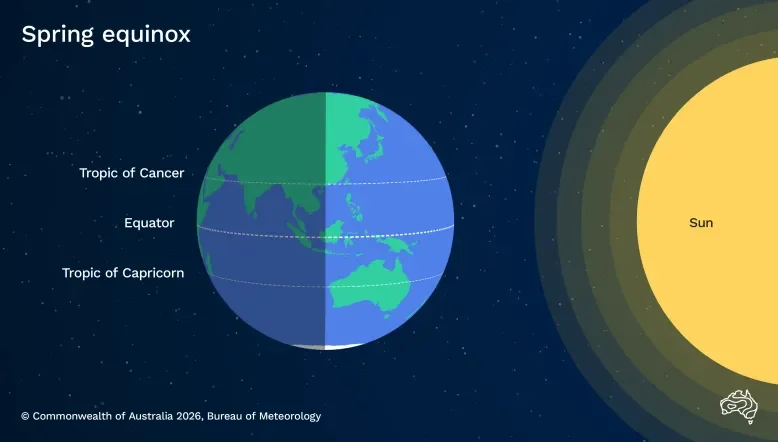
It is hard to believe that spring officially arrived astronomically on Friday. The weather here has been behaving as spring and summer so long it seems winter lasted three or four days. One of the best perks of living in the 956.
Across the globe, Spring is a time of special observances for many cultures. For the majority of folks in the RGV we observe Passover and Easter. For many religions the phases of the moon are the determinates of when most religious celebrations and observances are held. The phases of the Moon determine when the Jewish world commemorates the Feast of the Passover, April 2 this year, and the Christian world commemorates Easter on April 5. Many of our cultural celebrations are ancient and most of them are based on lunar or solar cycles. Have you ever wondered why Easter (and Passover) fall at different dates each year? It has to do with the phases of the Moon. The date that marks Easter Sunday and the celebration of the ancient Jewish Passover occurs on the first Full Moon after the spring or vernal equinox. Since the spring equinox will occur on March 20, this means after the Full Moon occurs on April 2 this year, then Easter will be observed on April 5.
The Jewish Passover marks the miraculous release of the Hebrews from slavery in Egypt. Yes, the ones who built those massive pyramids tourists still flock to see today. The story is wonderfully told in the Old Testament book of Exodus. The Easter story celebrates the death, burial, and resurrection of the Jesus in the New Testament books of Matthew, Mark, Luke, and John.
At the whims of springtime weather conditions, we are offered visions of splendor in our skies. Cloudy weather is welcomed when it brings rain for our crops and natural vegetation, but brings groans from star-gazers. What you see is what you get and if we are able to see stars from our viewing location, there are some traditional spring constellations to enjoy.
The curve of stars that mark the head of Leo the Lion are following closely behind Orion the Hunter. Resembling a scythe or the Soviet sickle, there are several fairly bright stars that form the curve and a brighter star just below the lower curve that marks the end of the handle. That star is called Regulus by current stargazers, but ancient Arab astronomers called it Qalb al-Asad, which means Heart of the Lion. It’s also sometimes called Cor Leonis, also meaning the Lion’s Heart. This same name was said to have been given to the English king, Richard the Lion-Hearted. Although it appears to be a single bright star, it is composed of four stars.
This week the Moon will be waxing which makes this a good time to pull out the telescope or binoculars and scan the terminator where the shadowed portion of the Moon and the illuminated side meet. Exploring this region brings great contrast of the craters that cover the lunar surface. Of course, the far side of the Moon has many more craters since it faces outward and was struck more often with comets, asteroids, and meteorites, leaving it battered and scarred. Lunar space missions obtained many images of its surface, but that side never faces Earth. Trapped by gravity we only see the near side of the Moon but space missions from several nations have provided intriguing images taken by orbiting spacecraft of the far side.
Naked eye observing may give a family a fun time imagining what they see in those darker areas on the lunar surface that are called maria (Latin for seas) by the ancient astronomers who spoke and wrote in Latin, the common language of education up until the twentieth century. Anyone who spoke Latin was more ready for the sciences and the literature courses then. Even royalty in the ancient times relied on those who read, wrote, and spoke Latin to serve officially in their realm. The darker areas were called a Texas Jack rabbit, a woman, and a man, just to name a few. What do YOU see? Let us know. <carolutsinger@att.net>
Until next week, KLU.
