
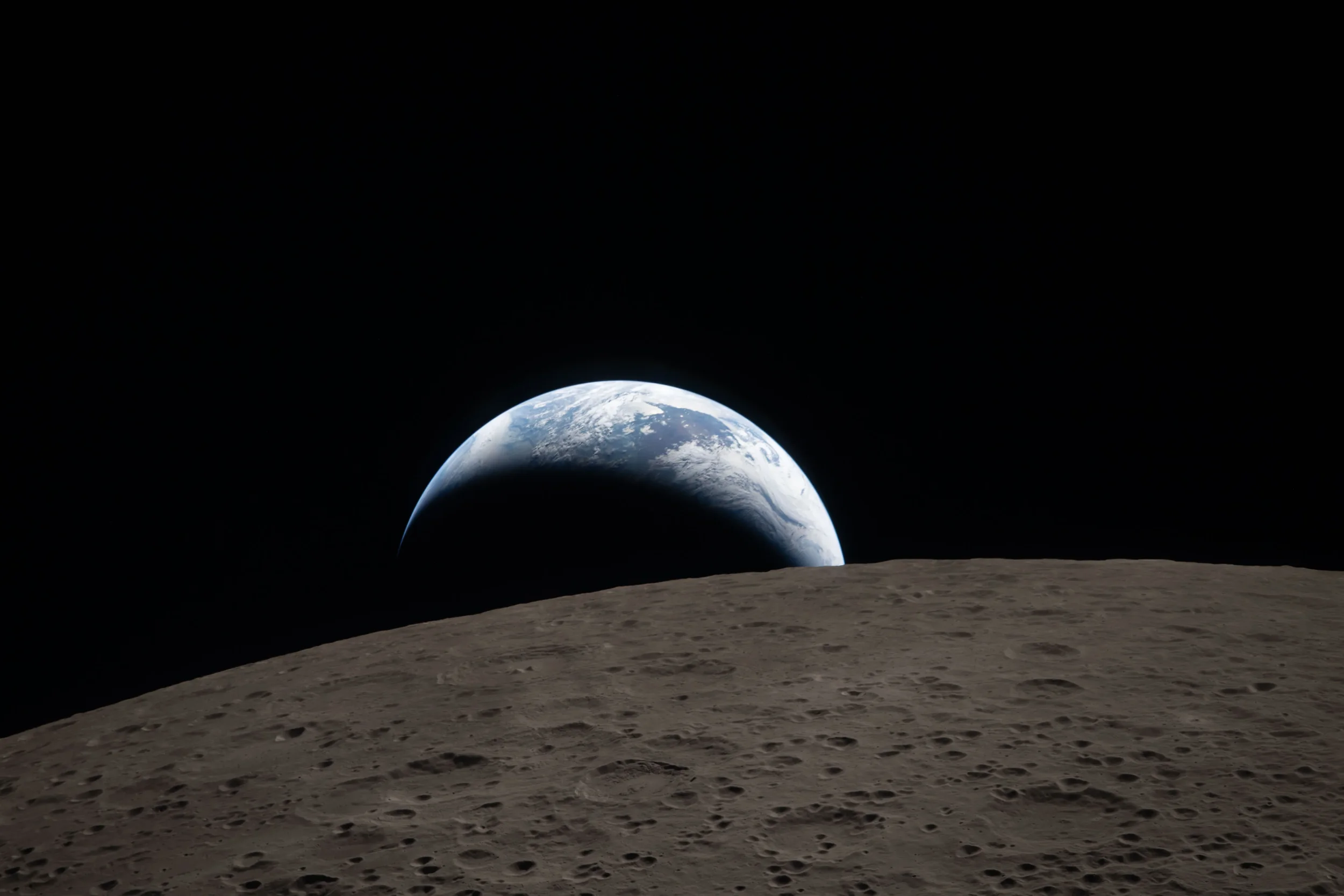
Image source: NASA
Spring Constellations & Artemis II
Rain. So welcome-even if it does mean we cannot see stars. But when the dust settles and we can see clearly it certainly makes us realize how important the balances are. So, if we have clear skies this week, we can look forward to the ho-hum usual spring constellations. And if anyone thinks it actually is ho-hum you may not have enjoyed a clear dark viewing site. And it is quite a sight to see those many points of light on a clear night far away from the skyglow of surrounding cities and towns.
I hope you have been following the travels of the four astronauts in the Orion capsule the NASA flight crew named Integrity. While Americans have walked on the moon in the past we had not returned because the focus on exploration of space had drifted towards the construction of the International Space Station. No matter what our political preferences might be each of us must realize the exploration is dangerous and meaningful to the future of our planet.
Beginning with understanding which direction is which, the sun rises in the east, seems to travel in an arc across the southern sky, and sink into the west. As we are heading into the summer season from our hemisphere we will notice the sun arcing higher each day until it is almost at the zenith about one o’clock in the afternoon. (We have to account for daylight ‘saving’ time.) Your shadow will be almost non-existent, just an inch or two from your feet. If you stand with your back to the sun you will be facing north. If you are a teacher you might want to take your students outdoors and let them trace one-another’s shadow on the ground early in the day and then go out again later, stand in the same spot and see what has happened to the length of those shadows.
When full darkness has set in, the brightest point of light will be slightly west of the zenith, Jupiter is very dependable and bright. The constellation Orion the Hunter is drifting farther towards the west, dropping lower, but still followed by Canis Major, or mama dog as my students used to call that group of stars. She is wearing the blazing bright star Sirius as her rabies tag. And since she is mama dog, who is heeling as she should, and of course her frisky pup Canis Minor is tagging along behind Orion’s shoulder higher than mama. Canis Minor is popularly called the hot dog for fun because only two stars are easy to see instead of the third that makes an outline of an upside-down Y.
Because of their location the stars in the north are not rising and setting. The north pole of earth points to the North Star and our planet’s rotation of west to east means the constellations in that part of the sky are circumpolar, slowly circling counter-clockwise like a merry-go-round whose center is the last star in the handle of the Little Dipper asterism which is part of the constellation Ursa Minor.
Regular readers will recall that an asterism is a smaller designated group of stars that create a distinct other pattern from the mathematically drawn constellation itself. The NASA Astronomy Picture of the Day shares this link APOD: 2011 May 14 - The Little Dipper
https://storage.noirlab.edu/media/archives/images/screen/ursa-minor-ann.jpg shows the entire constellation of Ursa Minor.
Throughout the year the two bears twirl as they try to escape from danger. From our perspective they will sink very low in the horizon and be almost invisible for a season, whereas farther north they can be seen all year long. The ancient myths from early civilizations that have been told and retold never seem to grow old. And countless generations of children have shivered listening to story-tellers who share the stories associated with each of the 88 standard constellations.
If your children are in a school district that has a portable planetarium available or the city library has one, ask about the astronomy programs available and encourage access to it for your Scout troop or other group. I taught school 40 years and whenever I see former students I ask them what they remember best about our year together. I have asked at least 70 of them; all but two have replied, ‘the stars in the big bubble’, meaning the BISD Starlab inflatable planetarium I was able to share with hundreds of students and teachers over the years, even at the libraries in the Valley for special events they hosted. Check with your local sources I mention and perhaps you will be able to encourage a presentation.
Until next time, do KLU.

