
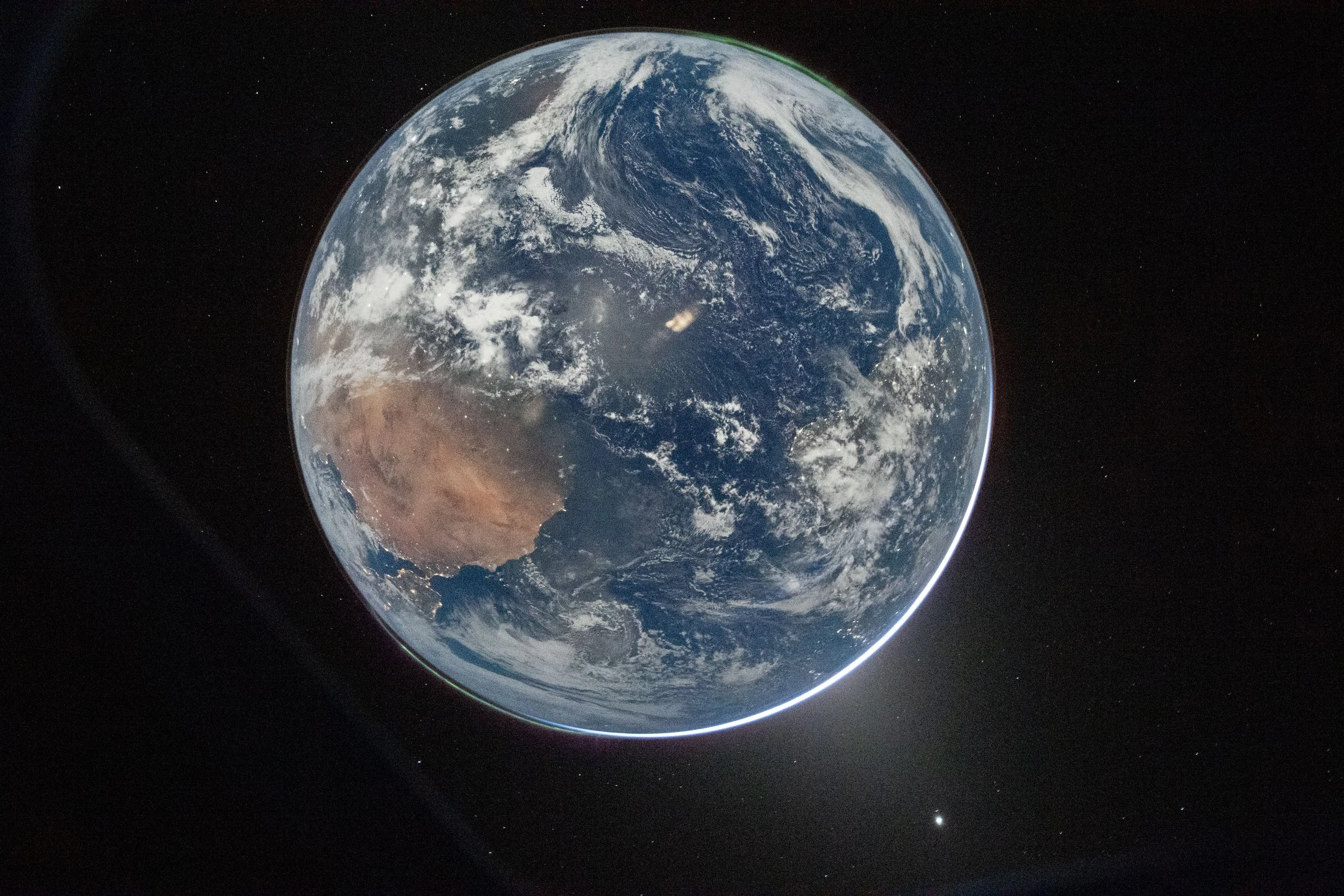
Image source: NASA
From Spaceship Earth
April is a good month for making a trip to the Moon, who is, according to mythology, Artemis, Apollo’s sister. And Apollo is the Sun. On April 27, 1972 the Apollo 16 astronauts landed on the Moon. John Young and Charlie Duke walked the lunar surface and had adventures driving the dune buggy moon-rover on the Descartes highlands, 7,400 feet higher than the Sea of Tranquility where earlier landings took place. Ken Mattingly kept the porch light on the orbiting home spacecraft. You might enjoy reading about Charlie Duke’s take on life after being a moon walker. He went on to begin a Christian ministry and spoke openly about walking on the Moon being not as amazing as walking with God. It was special to hear Astronaut Victor Glover speaking of his feelings about being where he was last week. Our folks who test missions to space are definitely a special breed of humans. To be without any way to be rescued should something go fatally wrong is a frightening thing for most of us. His bold expression of faith was revealing as to why he was willing to take that risk. They all have to have faith in the mission to sit on top of tons of explosive fuel and head off into the ‘wild blue yonder’ with only a thin metal skin between them and the vacuum of space.
The precise patterns of our solar system create the math which makes our space missions to our Moon and other space destinations possible to achieve amazing accuracy at landing sites. The Apollo 16 lander was less than 30 yards from the target area, near craters that could contain samples of lunar bedrock. One rock caught the eyes of one of the back-on-earth geologists watching and he indicated he wanted them to collect the football-sized rock they nicknamed “Big Muley” after the geologist who requested its recovery, William Muehlberger. Did you note how precise the landing was for Artemis II? That is math and engineering at its finest.
If you had to pay income tax this week you may not feel much like star gazing tonight but keep in mind there is no tax yet on stargazing. It does not need binoculars or telescopes, just eyes and dark skies. Someone to share it with is also nice, but not essential. To a beginner just looking up and noticing a bright group of stars is fun and that soon leads to wondering what constellation the group might be. Using a star map is easy once you know your directions. Of course there are all those apps for cell phones too, although I still prefer the printed paper ones for some reason. The apps don’t always show the stars exactly where they are, but off to the side a bit. https://www.heavens-above.com/skychart2.aspx used to be a printable only chart but look at it now and be amazed.
It helps to remember our spaceship earth rotates from west to east so that the sun appears above the horizon each morning in the general direction of east and set in the general direction of west. If you stand with your right shoulder facing east and the left one facing west, then your nose will point north. Raise your right arm so that your elbow joint is about level with your eyes and your fingers will point almost directly to Polaris, the North Star, the last star in the handle of the Little Dipper. Polaris, although not very bright is our guide star. There are few bright stars in the area; the ones that are bright are the stars of the Big Dipper that at this time of the year is sitting above the Little Dipper as darkness sets in. The two stars at the front of the bowl of the Big Dipper are known as "the Pointer Sisters" since they line up with Polaris.
If you allow your eyes to track along the arc of the Big Dipper you will come to a bright gold tinged star in the northeast called Arcturus. Keeping on that same arc is a blue-white star named Spica in Virgo. Still farther on is a trapezoid known as Corvus, the Crow. The mnemonic is "follow the arc to Arcturus, spike to Spica, and keep on to Corvus" in case you are interested.
Arcturus is in the constellation Boötes, the Herdsman. The shape resembles a traditional kite, with Arcturus at the base vertex where a tail of a kite would be attached. Spica is the ‘engagement ring diamond’ on the third finger of Virgo’s left hand. Representing spring cereal crops in mythology, Virgo has a sheaf of wheat tucked in her left elbow. Corvus is one of my favorite mythical characters who learns the hard way not to tell a lie to Artemis’s brother Apollo.
Until next week, KLU.
