
Wandering planets
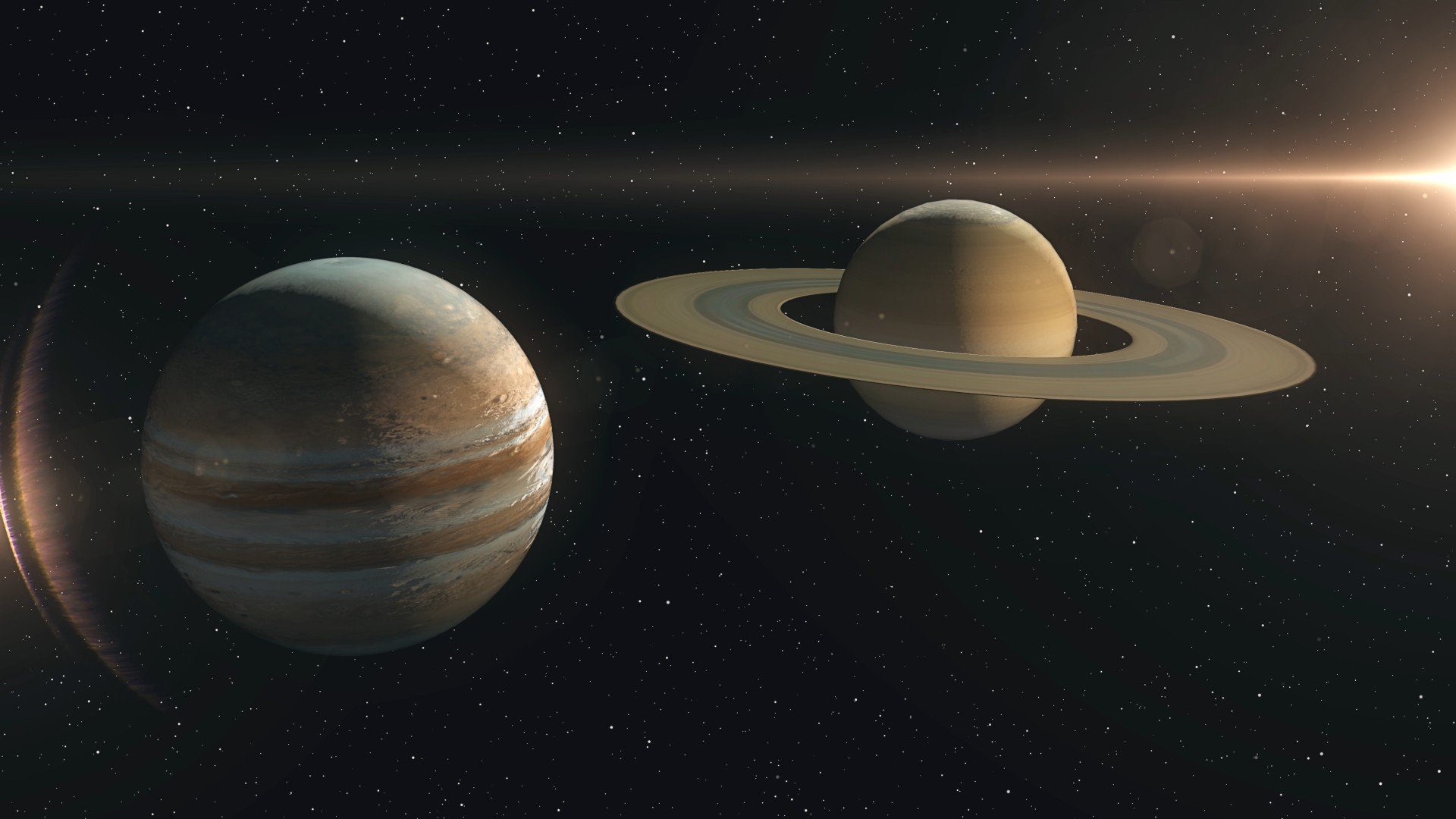
Image: NUS News
The first paragraph today is from the June 4, 2000 column. I am including it because I want to call to your attention to how the position of Jupiter has changed since then.
You who are early risers can start watching the sky just before sunrise to spot Jupiter and Saturn as they begin their stately pas de deux in the east as "morning stars". About an hour before sunrise is a good time to begin the watch. Keep track of the date and time that you first spot them; Jupiter will be the brighter one. For the next few months this lovely pair will grace the morning sky closer together than they will be for another 20 years. The precision with which astronomers predict the motions of the stars and planets reflects the grand design of the universe in great majesty. Nothing else in the cosmos is so predictable and reliable as far as I know.
Twenty-six years later Saturn is in the eastern sky about an hour before dawn. Jupiter rises before sunset and is in the sky until about midnight, is very dim, and lies just southwest of the star Pollux in Gemini. These planets give new meaning to the phrase "Far out!" Does this give you some idea of the vastness of space? You may enjoy going out for your evening stroll and locate Venus midway up from the western horizon. Stretch out your arms to form a narrow Y, right arm towards Venus, then look left and up to your other outstretched arm to locate Jupiter. Both planets will appear to be about the same size and but Jupiter will be dim, although Jupiter is often as bright as Venus, it is much farther from earth than the smaller rocky Venus. Venus is surrounded with a veil of sulfur dioxide and sulfuric acid that forms clouds that obscure the surface, but which is a great reflector of sunlight.
As the Earth continues its motion around the Sun and darkness arrives later each night until mid-June, Leo the Lion will be drifting farther west, sinking into the horizon after darkness falls. Look for the sickle marking his majestic head. The bright star at the base is Regulus, also called alpha Leo. Regulus is located directly on the ecliptic. Regular readers may recall that this is an invisible path the Sun and the Moon follow throughout the year. The ecliptic is also the location of any planets that may be in the sky on a given date. The brightest star in this group is called gamma Leo, and it is a binary star system of two yellow stars orbiting about one another.
Within the triangle marking Leo's hindquarters are beautiful open clusters of stars and a variety of other astronomical treats. With a good pair of binoculars under dark clear skies, many visual treasures may be garnered in an evening's observation. The brilliant star at the left vertex of the triangle is beta Leo, also called Denebola. This star is also a binary star system, one blue and one orange. The use of the Latin alphabet to denote the brightness of stars is still carried on today. Alpha is the brightest (ɑ)star in a given constellation, beta (ß), is the next, etc. You will see these letters on planispheres and astronomy maps. Sort of makes one want to learn that so-called "dead" language, doesn't it? https://apod.nasa.gov/apod/ap250321.html
Virgo is now high in the south with her brilliant diamond ring star Spica announcing spring is slowly turning into summer. She is followed by a massive constellation known as Ophiuchus; more on these two next week.
Look for the glorious splendor of Scorpius this evening. The fish-hook or J shape of the stars that comprise the constellation are easily discerned above the southern horizon as full dark sets in. Reddish Antares, the rival of Aries (Mars) will stand out and call your attention to it. Scorpius is followed by the old-fashioned teapot angles and triangles of Sagittarius. Both lie along the Milky Way and when you are looking in their direction you are looking out of our galaxy.
The Summer Triangle constellations will emerge from the eastern horizon after dark to grace the sky with Vega in the Lyre, Deneb in the tail of Cygnus the Swan, and the gleaming eye of Aquila the Eagle near midnight this time of the year.
I think astronomy is a natural means of interesting students in physics, chemistry, trigonometry, etc. because it is such a fascinating subject. Even literature, creative writing, and the social studies are relevant to astronomy. As the oldest science, it boggles my brain to realize that today it is often considered to be irrelevant in school curricula.
There are so many spectacular stars to enjoy; DO let some of them get in your eyes.
