
Entering summer
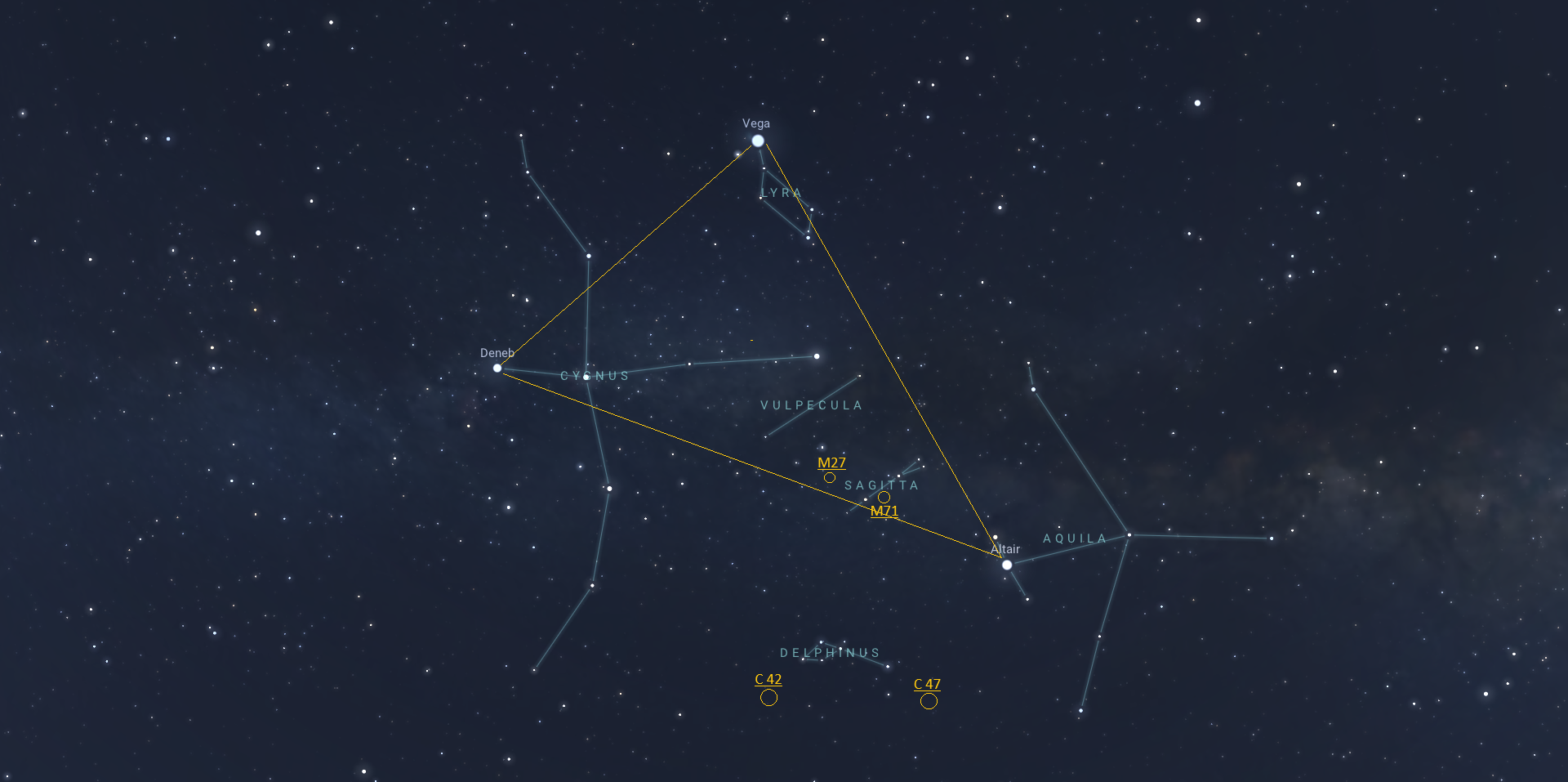
Image: NASA Science
Another month ticked off the calendar and a new season on the way, although we south Texans have had summer temperatures throughout spring. Gotta love it, and I do; I cannot imagine living anywhere else.
June 21 is the official date of the summer solstice, which means the sun appears to rise in the same spot along the horizon for a few days in a row, seem to travel from east to west across the sky dome to reach its highest point above the horizon, and sink into the western horizon again in the same point for several days. And all because our home planet is swiftly rotating from west to east while racing in its orbit around its star. Geometry is a math that could be more fascinating if someone added astronomy connections to the curriculum within the course in my opinion. Measuring degrees of angles would be more connected if its use in navigation and construction were clearly included.
As far as constellations go, the season brings two of the brightest stars, Arcturus in Boötes and Vega in Lyra, into better viewing position. Compare the magnitude of these two, which is zero, to that of Sirius, which is negative one, although Sirius is in the sky now at twilight and doesn’t seem as bright. Arcturus is nearly overhead, emerging as the sky darkness after twilight. It is an old star (about like me, lol) a puffed-up orange giant, about the same mass as our sun, but giving off more than 170 times its light and heat. Don’t mess with oldies.
Vega is part of the Summer Triangle asterism; Deneb in Cygnus and Altair in Aquila are the other points of light in the group. Vega is younger and hotter than Arcturus and appears to be white. As to mass, it has twice the Sun’s mass and is relatively close at 25 light years distance.
Last week we mentioned Virgo and Ophiuchus. Virgo contains the blue-white star Spica which is actually a two-star system whose combined light is more than 12,000 times more luminous that our star and many times larger. The stars in the area designated as Virgo do not resemble a reclining maiden, so don’t be disappointed at not seeing one. https://www.space.com/22049-spica.html
Ophiuchus, the physician, is another summer constellation that is in the south just above Scorpius, the scorpion. There are no bright stars in the first on, but a spectacular red one in the second-Antares. If you saw the blue moon Sunday night and spotted a reddish star near the moon that night you saw Antares-the rival of Mars.
The northwest will present the Big Dipper asterism, emptying its contents upon the earth as it appears to revolve counter-clockwise throughout the night like an endless carrousel. The stars that form the handle of the Dipper point to the North star-Polaris.
Venus and Jupiter will be in tandem in the west with the Moon passing through their invisible orbital curve during the month. It might interest you to make sketches representing their separation throughout the month. Sky-watching doesn’t have to be done with a telescope.
Until next week, do let some stars get in your eyes, KLU.
