
The Perseids
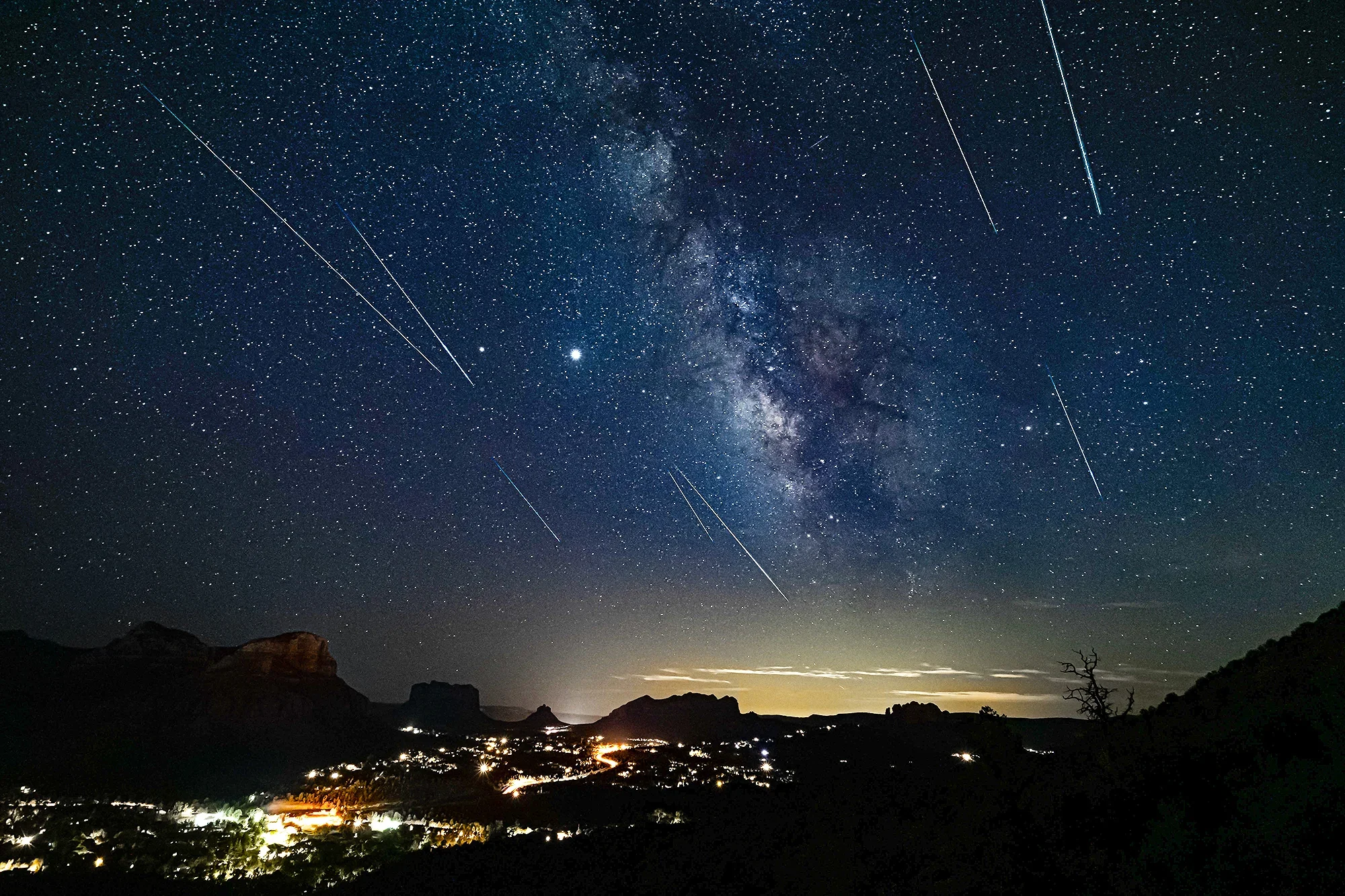
Image: Scientific American
Mark your special events calendar for the predawn sky on August 12/13 if you hope to ‘catch a falling star.’ The annual Perseid meteor shower will peak between the hours of midnight, and dawn, with the peak is about 2:00 AM. The Perseids are known for brilliant green streaks created as the particles from Comet Swift/Tuttle enter earth’s atmosphere. The Moon will be no problem since it is in the New Moon phase. They will appear to emerge from the constellation Perseus which from our location is northeast, high above the horizon. Even if you don’t see a meteor, there will be Mars after 4:00 AM among the constellations of Orion and Gemini, Taurus and Auriga to enjoy before their regular winter nighttime skies. And if you see me out and about, you can ask to see the meteorites I carry around with me.
Not sure which direction is northeast? If you stand with your right shoulder towards the area where the Sun appears each morning (east) and your left shoulder where it disappears (west), then your nose is pointing north. The back of your head is facing south. Halfway between north and east is…you guessed it; northeast.
If you stand facing north, left shoulder to the west, sunset, and your right to the east, sunrise, then you have a great view of Cassiopeia and her consort, Cepheus in the NNE. Cassiopeia looks like a letter W or M and Cepheus looks like a crooked little house with the roof peak to the left and slightly down. There are two stars in Cassiopeia that lead you to the North Star, Polaris, just like the two stars of the Big Dipper asterism when it is high in the sky. These northern- sky-region star patterns are called circumpolar due to the fact that Earth's rotation is in a west-to-east motion so the stars in the north appear to rotate counterclockwise throughout the night.
When you finish looking north turn around to Scorpius in the south and let your eyes drift upwards toward the zenith and see if you can pick out an elongated pentagonal shape with a few stars scattered to the east and the west of it. This pattern of stars is called Ophiuchus (O-fee-U-kus), the physician. The stars stretching out to either side are a serpent that he has divided with his hoe while working in his medicinal herbs garden. While chopping weeds out of his medicinal herb garden one day, he encountered a venomous serpent poised to strike. Ophiuchus used his hoe to chop the serpent in half. As it writhed along the ground in its death-throes, a second serpent appeared with a particular leaf in its mouth which it placed on the bleeding edges of the serpent that instantly reattached and both serpents slithered off to safety.
Ever the opportunist, the healer used the herb to heal all his patients; this aroused the ire of Hades, who was not getting any new boat rowers to cross folks over the River Styx. He complained about it and Zeus struck Ophiuchus with a bolt of lightning.
The Resaca de la Palma State Park/World Birding Center has a new Park Interpreter on-site; the night hikes may soon begin again. When they do I hope to be out there before the hikes and share some astronomy-based activity or story for the early arrivers. Those hikes provide opportunities to encounter night preferring critters and end at the Christina Torres Memorial Observatory for star-gazing. Check with the park for better information.
Until next time, KLU and catch a falling star.
