October Sky: Polaris, Cygnus, & More
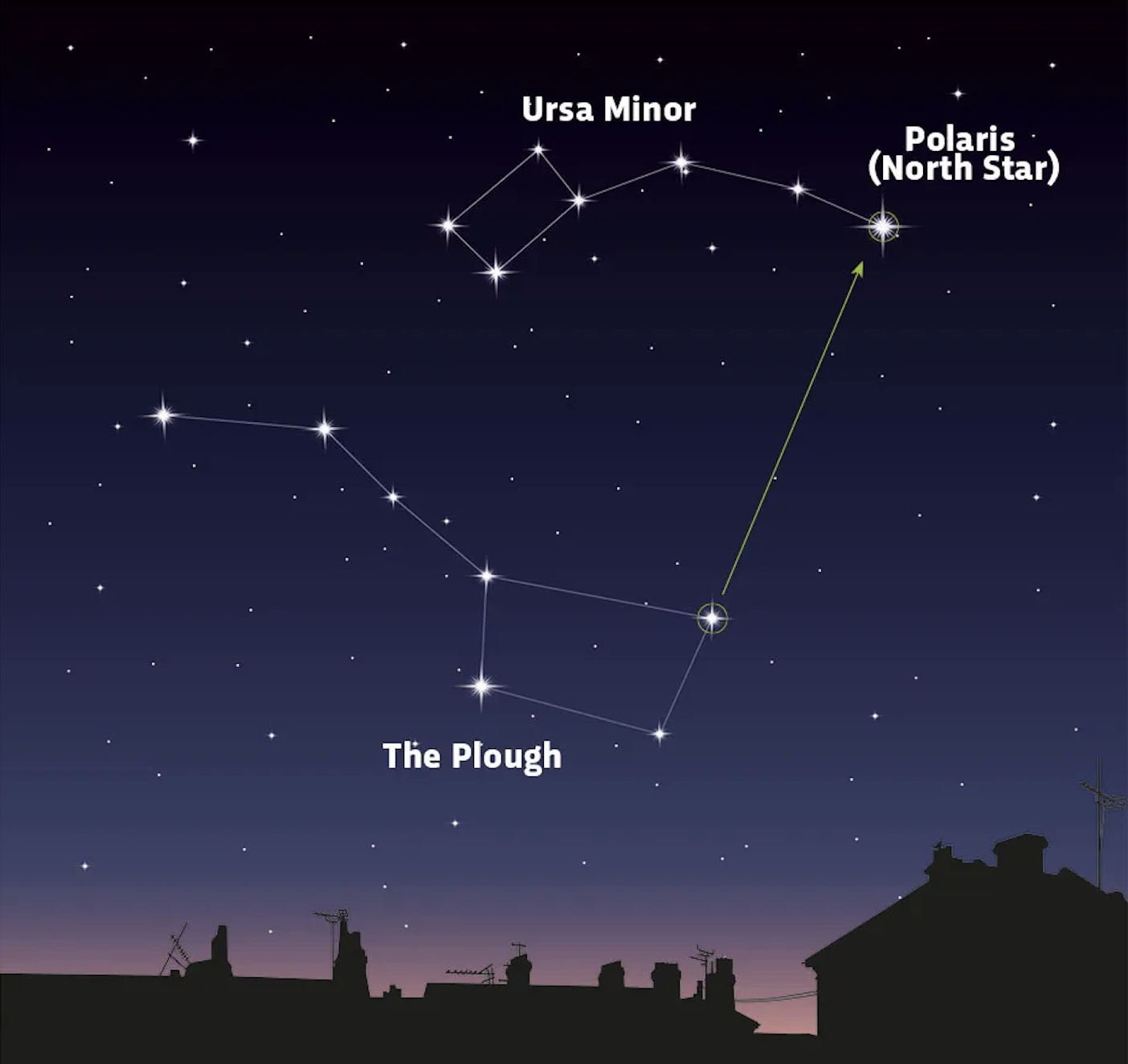
Image: Cosmic Pursuits
Welcome; I hope your week offered you some beautiful skies filled with colorful sunrises and sunsets. Have you recognized that the position of our home star along the horizon at those times is changing day by day? As Earth continues along its orbital path around Sol and tilts 23.5 degrees towards Polaris we experience a wonderful seasonal change in the various locations, depending on which hemisphere we call home. There are more noticeable changes in the regions farther north or south of the equator, but here in our area, the more temperate zone we still see changes to exclaim over. Even the sky color seems sharper on cooler days, at least to my eyes,
If your nighttime sky is dark and clear, stand facing the location where the sun set (west) and let your gaze drift north (right) to glimpse the handle of the Big Dipper asterism. Mizar, the middle star of the handle has a companion star, Alcor. Known as “the horse and rider”, ancient folks used the pair to check eyesight. If two stars were seen your vision was phenomenal. The three stars are named Alkaid, Mizar and Alioth, with Alcor being the rider of the middle star. All appear to be the same distance from one another but that is not the case. The stars of the bowl are Megrez, Phecda, Dubhe, and Merak. Dubhe and Merak point the way to Polaris, the last star in the handle of the Little Dipper.
The Summer Triangle is still monopolizing the zenith of the sky, with the bright star Vega farthest west, Altair closer to the southern horizon, and Deneb near the zenith itself, almost due south. The faint stars of Delphinus the dolphin, Sagitta the Arrow and Vulpecula the Fox are clustered between the Great Square of Pegasus and the constellations Cygnus the Swan marked by Deneb, and the Eagle marked by Altair. From a safe dark site, the group is lovely and worth driving out to the beach or deer lease to see it best.
Cygnus resembles a sword or cross so it goes by the name Northern Cross as well as Cygnus. The point of the blade or the nostril of the beak of the swan is actually a pair of stars orbiting one another, one blue and one orange.
If you are up waiting for the school bus before sunrise, then look for a formation of three stars almost the same apparent size and brightness on a diagonal between a bright red star to the upper left, and a bright blue-white star to the lower right. Your entire hand, held palm-flat can probably just about cover the group if your arm is fully extended. The entire group is called Orion, the Hunter. The red star is named Betelgeuse, (BET-al-juz), which translates from Arabic as the armpit or hand of the giant, depending on the source. Betelgeuse is a red super-giant star that has swollen to unimaginable dimensions as it throws off its outer layers of hydrogen and helium, which becomes cooler, at least relatively speaking! If this star were OUR sun, then we would have been vaporized long ago and not exist. All of the planets from Mercury through Mars would also have been destroyed.
You may know I really enjoy reading; after sharing the video of October Sky a couple of weeks ago at the local library I ordered Homer Hickam’s new book Don’t Blow Yourself Up! It is a follow-up of his ensuing years in college where he and some friends built an exploding cannon for the football games. Continues with his service in the Army as an engineer; continuing at NASA working with Skylab; and into the International Space Station adventure. If you are interested in any of those, it is a wonderful read. Skylab: The First 40 Days | NASA's First Space Station | Original Documentary - YouTube
Will you be one of the folks attending the Greater Brownsville Space Summit on November 4? The invitation-only event will have astronaut Jose Hernandez as the keynote speaker. Our city is rapidly changing and growing with its vital asset the Port of Brownsville and the activity at Space X and the assorted connected companies who are finding our area a wonderful place to grow. With wise decisions to make over the next few years this type of communication experience will definitely be vital. Staying ahead of other competing international efforts in the space and technology areas will be essential for our children and grandchildren’s economic conditions in the 956. Keep an eye on the sky and the future.
Until next weekend, KLU.