Image: The Amazing Sky
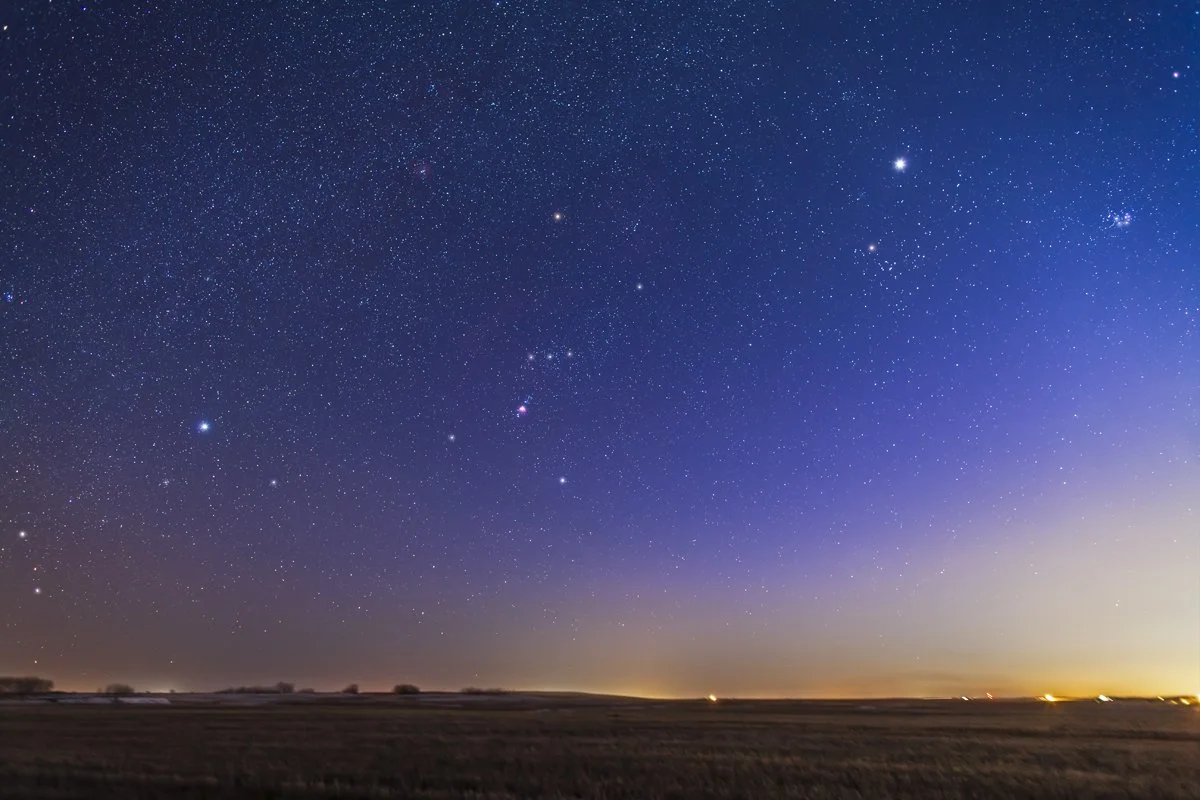
Early darkness is a plus for young stargazers who are going to be able to see plenty of constellations before their nine o'clock bedtime. Look in the east-northeast for a glittering reddish colored star at the lower tip of a V lying on its side, open end towards the north. This is Aldebaran, the eye of Taurus the Bull. The entire cluster of stars is known as the Hyades. (HIGH uh deez), although Aldebaran is not actually part of the cluster. Just above the Bull is the delicate open cluster of stars surrounded by a cloud of haze called the Pleiades (PLEE uh deez), the Seven Sisters.
The Great Square of Pegasus is nearly directly overhead, with a graceful swoop of stars coming off the lower left star of the square to a viewer facing east and looking upward. Those stars are the constellation Andromeda. The three brightest stars of the constellation are named Alpheratz, Mirach, and Almaak. Each star is almost identically bright and the visual distance between them is almost the same as well, but the distances to travel from one to the next is very different, so their luminosity looks very different as well. Alpharatz is white, Mirach is a deep orange and Almaak is actually a double star, one a light orange, the other a greenish blue. Still facing east there is a small isosceles triangle of stars known as Triangulum and also two galaxies in the region between Pegasus and Triangulum, M31, the Andromeda Galaxy https://sky-tonight.com/object/nebula/M31and M 33https://science.nasa.gov/image-article/apod-2025-january-30-hydrogen-clouds-of-m33/.
When a norther comes in and brings sharper views of the stars the colors that shimmer out of the darkness add an extra pleasure to star gazing. It is definitely more difficult to see stars or meteors in the 956. I did meet a young man who works for our friendly neighboring spacecraft builder and launcher who told me he enjoyed a view of some Leonids during the past week. Did you see any?
If the skies are clear enough, look for the blur of the Seven Sisters, the Pleiades, above Orion. In even a small pair of binoculars, this open star cluster will reveal more stars than can be seen with the naked eye. Photo images reveal a veil of blue gas surrounding them, which gives it a delicate ethereal hue. Astronomers think this is left-over gas from star formation and that these stars are young, only 20 million years old. No wonder I like astronomy, if that is considered young. The brightest star, Alcyone, is a thousand times brighter than the sun.
If you enjoy staying out late, watch Orion as he appears to move across the sky 15 degrees every hour toward the west. One handspan equals 15 degrees. This is the same distance the sun appears to move in that length of time. In 24 hours, Orion will move from east to west, pass beneath the earth, and rise again from the east in an endless cycle. That there are many cycles in science and that change occurs over time are two of the BIG ideas in the science standards designed for our students. Other motions can be traced with the planets. Night owls can enjoy Saturn while early risers can enjoy Venus, Mars, Jupiter, and possibly Mercury in the east just before sunrise.
If you have yet to watch the NASA video Seven Minutes of Terror about the landing of the Curiosity Rover on Mars, https://www.youtube.com/watch?v=Ki_Af_o9Q9s watch it on the internet and think about the possibilities happening in our own front/back yard. The precision of the successful landing of a mission on another planet is a phenomenal accomplishment. It is only possible because our solar system works on math and humans understand the math it takes to reach the red planet. Half of the Mars missions don't make their goal; even attempting to reach Mars is a huge risky scientific endeavor involving thousands of personnel from all walks of life. Be proud of the folks who are working on this at Boca Chica. Did you know in 1936 a sixteen-year-old boy was building rockets in his backyard HERE?
December and the winter solstice will bring many different cultural celebrations from across the globe. We have gathered folks from many regions that celebrate a variety of customs for sure. When someone says ‘happy holidays’ they are not belittling the local traditional ones, just trying to be sharing good wishes from themselves to our part of the world.
P. S.The local South Texas Astronomical Society has an event being planned for the solstice at Resaca de la Palma State Park; I will let you know when the details are set.
Until then, KLU. Carol <carolutsinger@att.net>