Birds of a feather, flock in space together
How a flock of cartoon birds brought physics down to Earth, and beyond
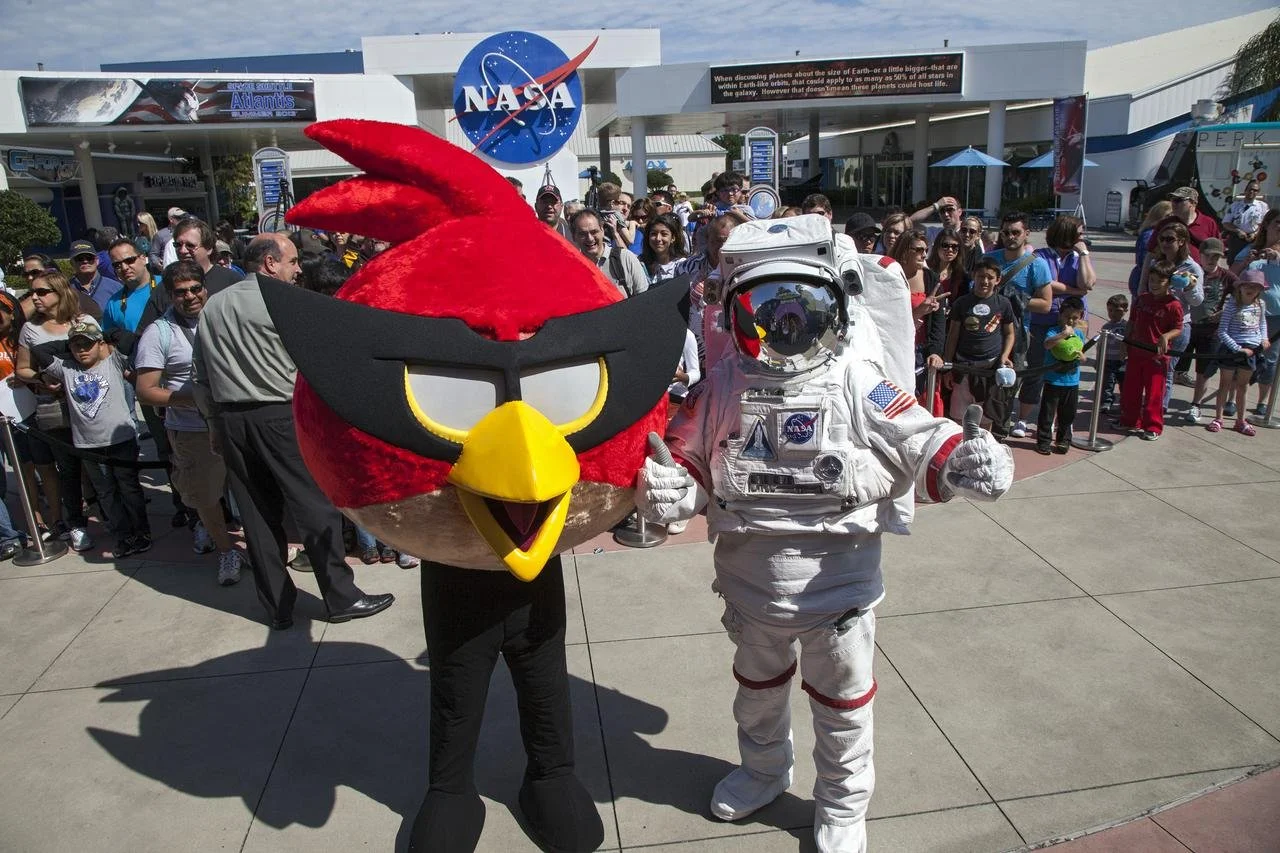
At NASA’s Kennedy Space Center Visitor Complex in Florida, the Spaceperson and Red Bird, one of the Angry Bird characters, welcome visitor to the Angry Birds Space Encounter grand opening ceremony. Finland-based Rovio Entertainment, the creator of the Angry Birds Space game, partnered with Kennedy Space Center to bring the beloved characters to life. It is the first Angry Birds interactive exhibit in the United States designed for people of all ages. The 4,485-square-foot facility hosts the space adventures of the Angry Birds as they travel into an intergalactic wormhole, come face-to-face with Space Pigs and discover heroic superpowers. Six interactive stations are designed to encourage children in science, technology, engineering and mathematics fields of study.
PHOTO COURTESY NASA/KIM SHIFLETT
In 2012, millions of players launched a flock of cartoon birds somewhere they had never gone before: space.
Angry Birds Space, released by Rovio Entertainment three years after the original Angry Birds, took the familiar slingshot formula and placed it among planets, asteroids and outer space. The birds received futuristic designs and new abilities, but one of the game's biggest changes was not cosmetic. Players suddenly had to incorporate gravity into their gameplay.
Instead of following the predictable arcs of the original game, birds could become caught in the gravitational pull of nearby planets, orbit around them or travel through areas without the planet's gravitational pull. Concepts from physics had become part of solving a puzzle.
And that connection to science was intentional.
Rovio partnered with NASA during the development of Angry Birds Space to introduce players to physics and space exploration. Before the game's release, NASA astronaut Don Pettit demonstrated its concepts aboard the International Space Station, using an Angry Bird and a makeshift slingshot to explain how trajectories behave in microgravity.
The collaboration continued after launch. Following the Curiosity rover's arrival on Mars in August 2012, Angry Birds Space received its "Red Planet" episode, bringing the rover and NASA's exploration of Mars into the game's world.
Games can provide a way to encounter concepts such as gravity and motion outside a traditional classroom. Instead of only reading about how an object moves, players can interact with those concepts and see the results.
Soumya Mohanty, a University of Texas Rio Grande Valley physics professor with a doctorate in physics, said video games can build on an understanding of physics people already develop by interacting with the world around them.
“We do physics simulations all the time in our brain,” he said. “Like if you are throwing something, a basketball or something, your brain is already computing a parabolic trajectory.”
A player may not know the equations describing that trajectory, but a game can allow them to experiment with it. Changing the speed or angle of an object and seeing the result can provide a visual introduction to the mathematics behind its motion.
Mohanty put that idea into practice through a physics course taught entirely through commercial video games. Rather than relying on textbooks and traditional lectures, students played games including LittleBigPlanet, Uncharted and Gran Turismo while completing activities designed around different physics concepts.
“Everything was hands-on in that course,” he said.
The professor explained in games like Gran Turismo, students used the racetrack to examine concepts such as speed and acceleration.
“It’s very easy to see in a video game,” Mohanty said. “What happens when you're just coasting along at a constant speed? What happens when you're accelerating?”
Angry Birds Space is far from the only game to draw inspiration from the universe. Games such as Kerbal Space Program turn orbital mechanics and spacecraft design into challenges, while titles such as Universe Sandbox allow players to experiment with planets, stars and gravity on a cosmic scale. NASA itself has experimented with gaming as an educational tool, including Moonbase Alpha and Mars Rover Landing, which challenged players to safely land the Curiosity rover on Mars.
Games do not have to be perfect simulations to spark curiosity. Sometimes, all it takes is an interesting world, a new mechanic or even a cartoon bird falling into orbit to spark wonder over what is really happening beyond Earth.