He was right to dream big
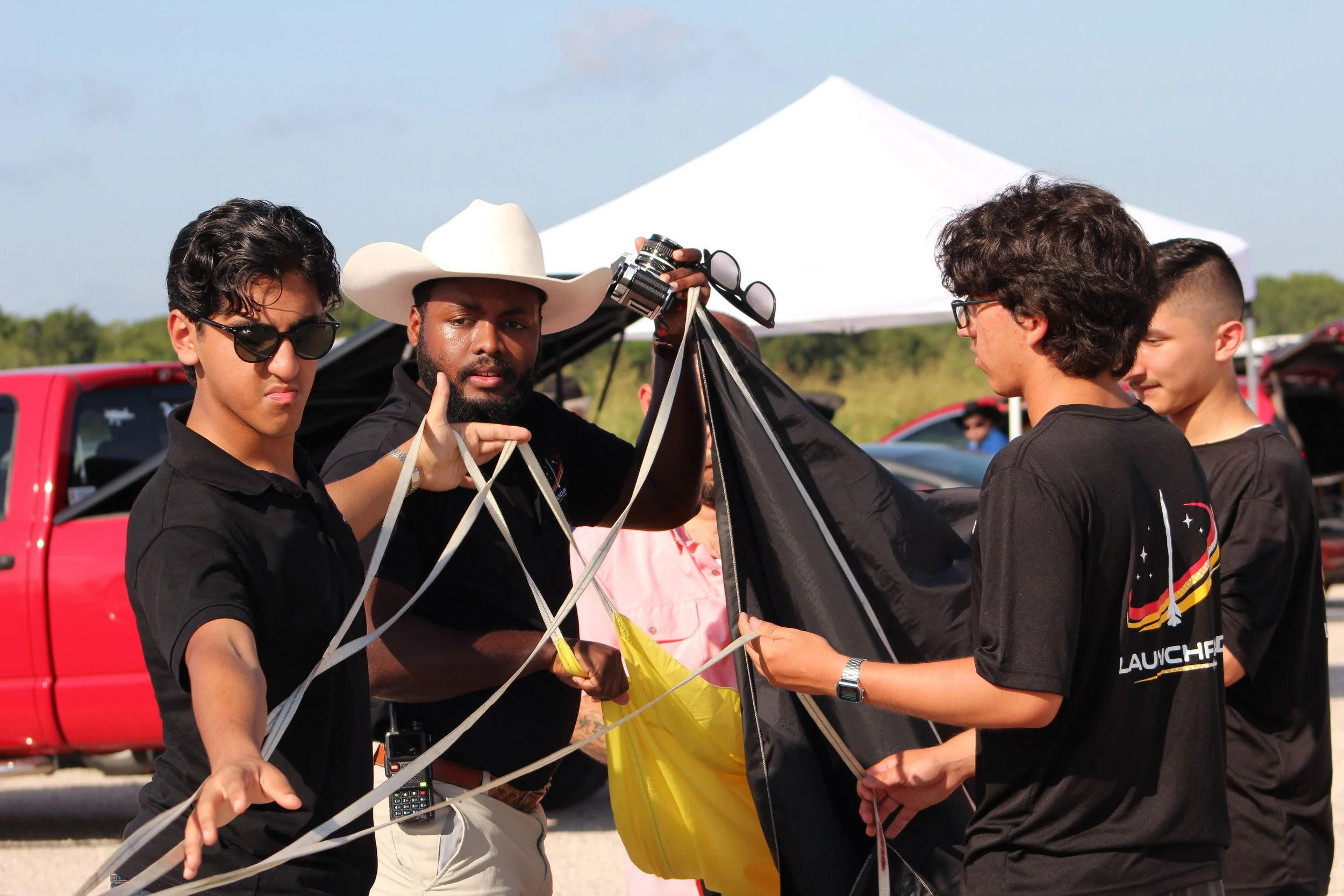
From left, Rayyan Farooqui, Phil Donaus, Massimiliano Marin-Mera and Aldo Araujo prepare parachutes for Project Vortex’s flight recovery system Aug. 8 outside Hearne Municipal Airport.
Marcelina Gutierrez | THE COSMIC CURRENT PHOTOS
Guest Writer | Massimiliano Marin-Mera
When I was a kid, my favorite time of day was bedtime. I would lie down, close my eyes and imagine myself somewhere among the stars. Sometimes I was a starship commander, leading formations of X-wings into battle. Other times, I was Luke Skywalker. I knew every scene by heart, and I could hear Han Solo in my head saying, “You’re all clear, kid. Now let’s blow this thing and go home!” I would replay those moments until I eventually fell asleep.
It followed me during the day, too. I remember lying in the cold Minnesota grass and turning my yard into something completely different. Clones marched across it. Spaceships filled the sky. Entire worlds existed in a place that, to everyone else, was just a backyard.
This was the beauty of being a kid. You don’t really understand the boundaries of what is possible, so you simply don’t have any. You imagine first and ask whether it is realistic later.
Looking back, though, there is one word which separates those memories from what eventually happened: imagined. Those were my wildest dreams. Never in a million years would I have believed that one day I would actually get to create something of that magnitude.
Then I moved to South Texas, to Brownsville, a city I never would have imagined becoming such an important part of my story. Somehow, space followed me there. I watched SpaceX grow from a handful of buildings on Boca Chica Beach into what is now Starbase. I went to every launch I could, and I remember seeing the first booster get caught.
The excitement felt strangely familiar. It was almost the same feeling I had as a kid imagining spaceships in the sky, except this time it wasn’t imaginary. It was real. The future I had only watched in movies was suddenly happening a few miles from where I lived.
Maybe this changed the way I thought about my dreams. Maybe they didn’t have to remain imaginary. I just didn’t know yet what I was going to create.
Then, through RioProgress, I met Phil Donaus. I told him about my interests, and he said, “I have the perfect thing for you.” He told me about Launchpad and encouraged me to apply. I have filled out a lot of applications in my life, but I can wholeheartedly say that one was among the most impactful. Launchpad gave me an opportunity to take something I had spent years watching and imagining and actually build it.
Launchpad brought together some of the brightest and most passionate students in the Rio Grande Valley, from Brownsville to Mercedes and everywhere in between. Many of us came in with little to no experience building rockets, yet somehow we were given the almost impossible task of building a 12-foot Level 3 rocket.
Project Vortex was fun for exactly that reason. We got to learn in the best way possible: by failing. For every breakthrough, there was a bump in the road. Something didn’t work, something broke or we realized we had been thinking about a problem completely wrong. But that is the beauty of building something and, I think, the beauty of passion.
I recently watched “Spider-Man,” and I heard a quote attributed to Mark Twain: “Find a job you enjoy doing, and you will never have to work a day in your life.” I thought about Launchpad when I heard it.
Every one of us genuinely enjoyed going to the shop and working for hours on end, sometimes knowing exactly what we were doing and sometimes having absolutely no clue what direction we were going — or even questioning why we were doing it in the first place.
But we kept coming back. We kept soldering, designing, testing, fixing and trying again because we cared about what we were building. Somewhere in all those hours, the rocket became more than a rocket.
Launchpad’s biggest accomplishment might not have been Vortex itself, but everything that happened while we were building it: the hard work, the discipline, the failures that forced us to become better and, my favorite, the people. Teammates became friends, friends became family, and somewhere between the late nights and the moments when we had no idea what we were doing, we built something that will last much longer than any rocket could: an eternal family of fellow rocketeers.
Then, on Aug. 8, we watched Project Vortex leave the ground.
Twelve feet of calculations, mistakes, corrections, late-night soldering and memories became a streak against the sky. It reached approximately 8,300 feet and a maximum velocity of 902 feet per second. Most importantly, we got it back.
But as I watched it disappear into the sky, I kept thinking about that kid in Minnesota. The kid who would lie in the grass and imagine entire worlds above him, who had no idea that one day he would move to South Texas, watch rockets launch from Starbase, meet people who would change his life and eventually help build one himself.
It is funny how little we understand our own dreams when we’re young. We imagine things because they are cool, because they make us happy, because they feel impossible. We don’t imagine them wondering whether they will ever become real. And then, somehow, you grow up and find yourself standing underneath the thing you once thought could only exist in your head.
For years, I thought the coolest thing I could ever do was command an X-wing formation. I was wrong.
Standing there on Aug. 8, watching Vortex disappear into the sky, I realized the coolest part was never pretending to be the person in the cockpit. It was being surrounded by people who were willing to spend months figuring out how to build something that could actually get there.
So cheers to Project Vortex, to LAUNCHPAD, to every failure that became a lesson, every late night that became a memory and every person who made this possible. And, most of all, cheers to that kid lying in the Minnesota grass, dreaming up worlds he thought could only exist in his head. He was right to dream big. He just couldn’t have known where those dreams would take him.
None of this would have been possible without the people who believed in us before there was anything to prove. To STX Metal Trades, thank you for providing a place to work and for seeing the ups and downs of this journey firsthand while continuing to believe in us. To H-E-B and GBEDC, thank you for believing in a ragtag team of high schoolers attempting something that had never been done in our area. To the South Texas Astronomical Society, thank you for facilitating and hosting our program and for having faith in this idea from the beginning.
What started as something we could only imagine became something we could finally hold in our hands, launch into the sky and bring back home. For that, I will always be grateful.