Border plans raise concerns over big bend’s dark skies
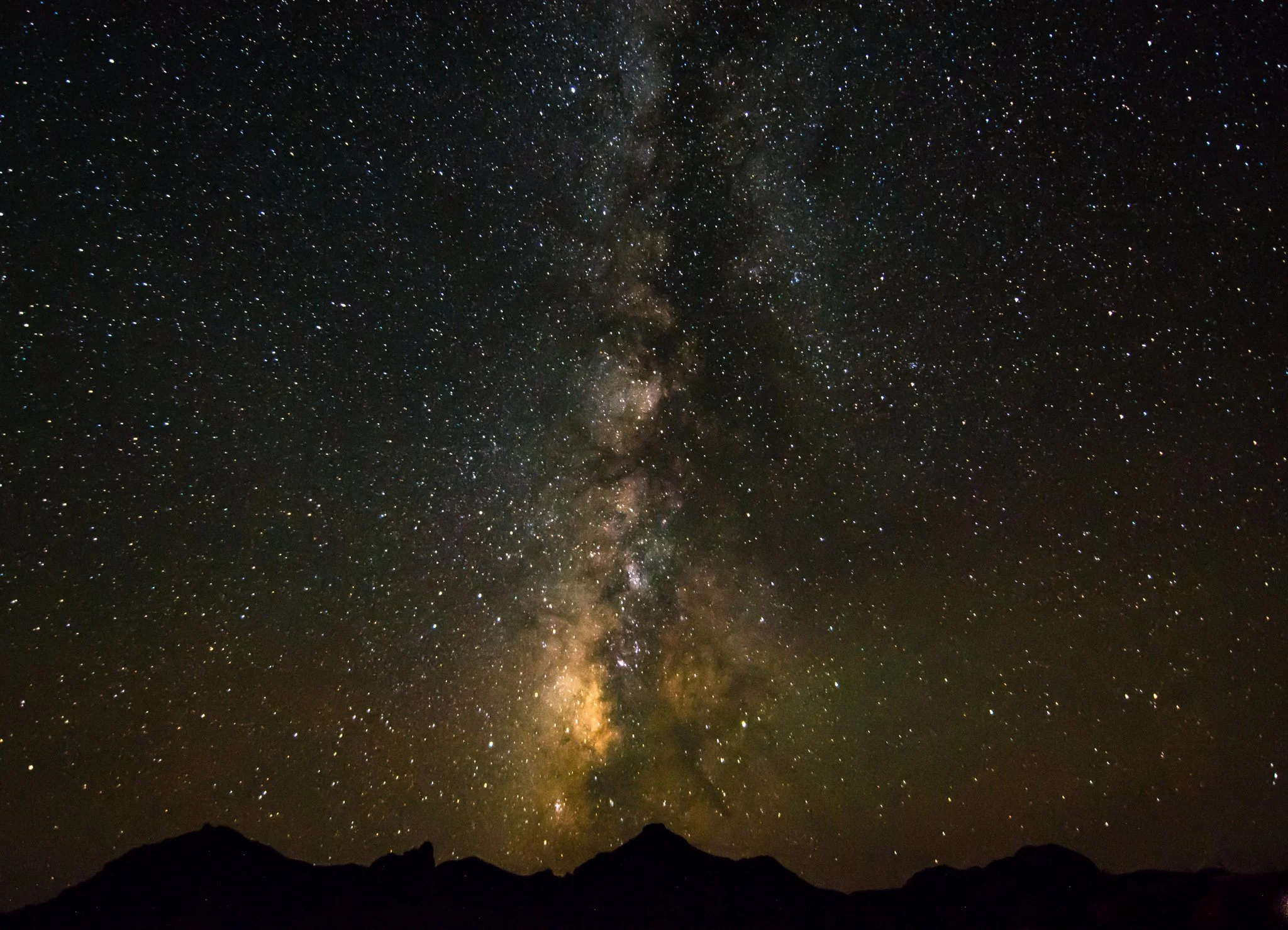
The glow of the Milky Way backlights the silhouette of a mountain range as seen from Panther Junction.
PHOTO COURTESY NATIONAL PARK SERVICE/L. BARTSCH
The Department of Homeland Security announced plans earlier this year to build approximately 175 miles of border infrastructure along the U.S.-Mexico border in and around Big Bend National Park.
DarkSky International has raised concerns that construction and associated lighting could affect the Greater Big Bend International Dark Sky Reserve, an internationally recognized protected dark-sky region.
The plans also drew opposition from groups throughout Texas, including People of La Junta, which argues projects could threaten the region’s ecosystem, dark skies and archaeological sites.
Protected Dark Sky Reserve
The Greater Big Bend International Dark Sky Reserve spans more than 9 million acres and includes protected areas in the United States and Mexico. It is the world’s first binational International Dark Sky Reserve.
The McDonald Observatory, a research facility of the University of Texas at Austin, sits within the reserve and is home to several telescopes, including one of the world’s largest optical telescopes, the Hobby-Eberly Telescope, according to its website. The observatory works with regional communities and businesses through its Dark Skies Initiative to preserve the region's night skies.
The reserve includes Big Bend National Park and Big Bend Ranch State Park along the U.S.-Mexico border in the Chihuahuan Desert.
Earlier proposals for the Big Bend region contemplated more than 500 miles of border infrastructure, including 30-foot barriers. By May, federal plans had shifted to approximately 175 miles of proposed infrastructure, with uncertainty remaining over what type of barriers would be built and where, according to reporting by Marfa Public Radio.
Border Security Plans
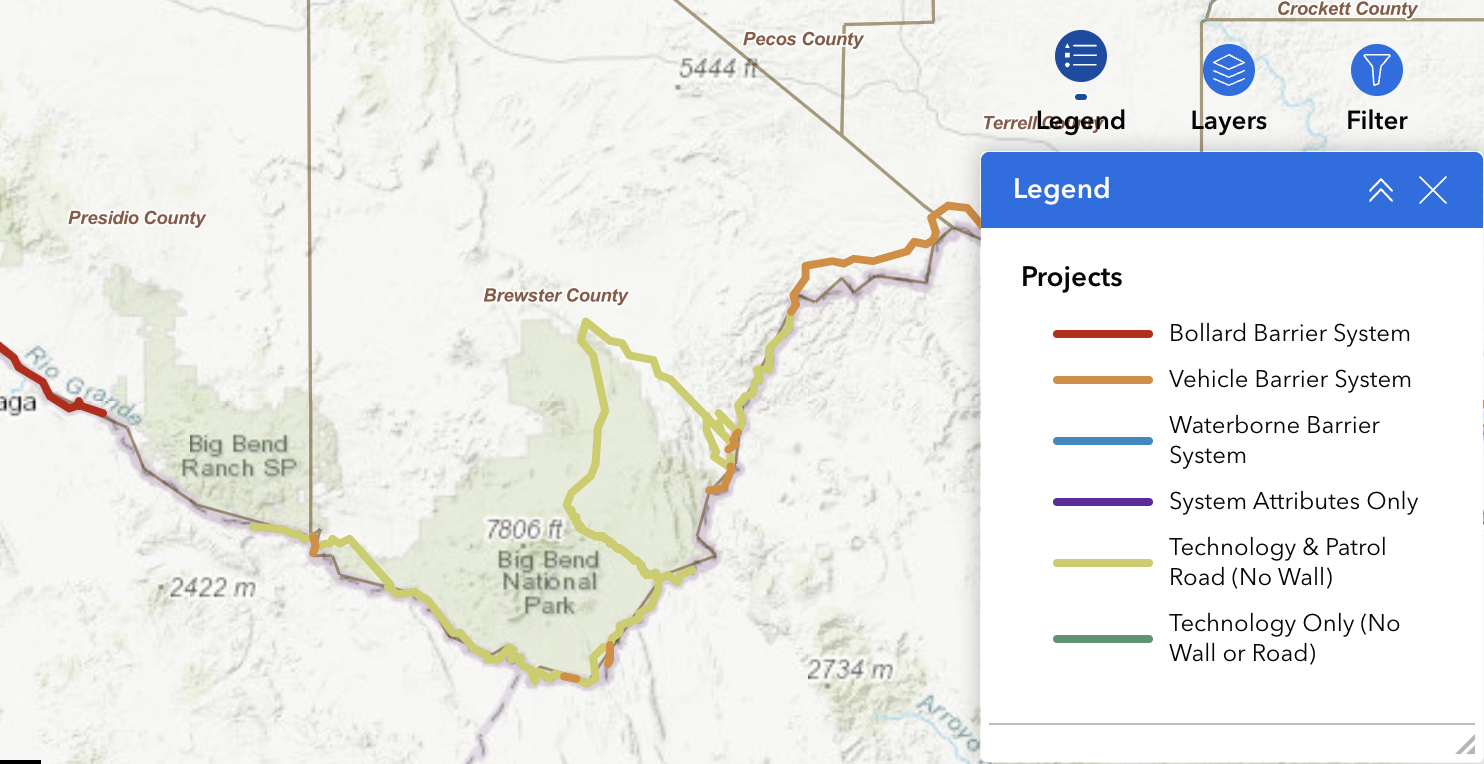
CBP Border Wall with Legend
IMAGE COURTESY ESRI, HERE, GARMIN, FAO, NOAA, USGS, EPA, NPS
Federal plans for the Big Bend Sector have included physical barriers and roads, along with supporting elements such as lighting, cameras and sensors. In an Aug. 13 CBP statement, Customs and Border Protection Commissioner Rodney Scott said plans for Big Bend National Park and other protected areas included one new access road, improvements to existing roads, detection technology and vehicle barriers in limited locations.
Scott said the agency has no plans to build 30-foot walls or place stadium lighting through Big Bend National Park, Big Bend Ranch State Park or Black Gap Wildlife Management Area. He said the infrastructure is necessary for border security and emergency response.
“These improvements will help our agents detect illegal crossings, respond faster, and assist visitors in danger,” Scott said.
Although the Big Bend Sector makes up about a quarter of the entire U.S.-Mexico border, it accounted for about 1.3% of apprehensions in fiscal year 2025, according to federal data reported by the Texas Tribune.
Opposition and Legal Challenges
Opponents argue additional infrastructure is unnecessary because the region’s rugged terrain acts as a natural barrier. They also say construction could damage the landscape and ecosystem while negatively affecting the region’s tourism economy.
Two groups opposed to construction are Save Big Bend and No Big Bend Wall. They and others protested at the state Capitol in Austin in April. Amid opposition to the projects, Scott announced Aug. 17 that construction work was paused pending further review.
The projects have also faced legal challenges. The Center for Biological Diversity, Friends of the Ruidosa Church and Big Bend-area river guide and landowner Billy Miller filed a lawsuit challenging the federal government’s use of legal waivers to expedite border infrastructure construction in the region. The plaintiffs later sought a preliminary injunction to halt construction while the case proceeded.
Earthjustice, a nonprofit environmental law organization representing the National Parks Conservation Association, Sierra Club and its Lone Star Chapter, filed an amicus brief supporting the Center for Biological Diversity’s lawsuit.
“Big Bend National Park was protected for a reason: it is regionally, nationally and globally important for many species, and we are going to fight to protect it,” said Meghan Riley, a senior attorney at Earthjustice.
Concerns for the Night Sky
The Big Bend region is known for its exceptionally dark night skies. According to Dark Skies Atlas, Big Bend National Park is rated Class 1 on the Bortle Scale, a nine-level scale of night-sky brightness in which Class 1 represents the darkest skies.
Opponents of proposed construction have raised concerns that lighting associated with construction, patrol roads and other infrastructure could increase light pollution in the region. They say additional artificial lighting could reduce visibility of stars and other celestial objects and interfere with astronomical research conducted in the region, including at McDonald Observatory.
In a Sept. 9 email to The Cosmic Current, Stephen Hummel, Dark Skies Initiative coordinator for the McDonald Observatory, said CBP stated the impact of the border infrastructure would be minimal.
Hummel said he was told CBP does not intend to install lighting with border infrastructure in the Big Bend Sector, instead using infrared illuminators which are not visible to the eye in rural areas.”
Hummel said infrared light “does not scatter significantly in the atmosphere, so there is no noteworthy impact anticipated” at the observatory.