Equinox 101: Earth’s Moment of Perfect Balance
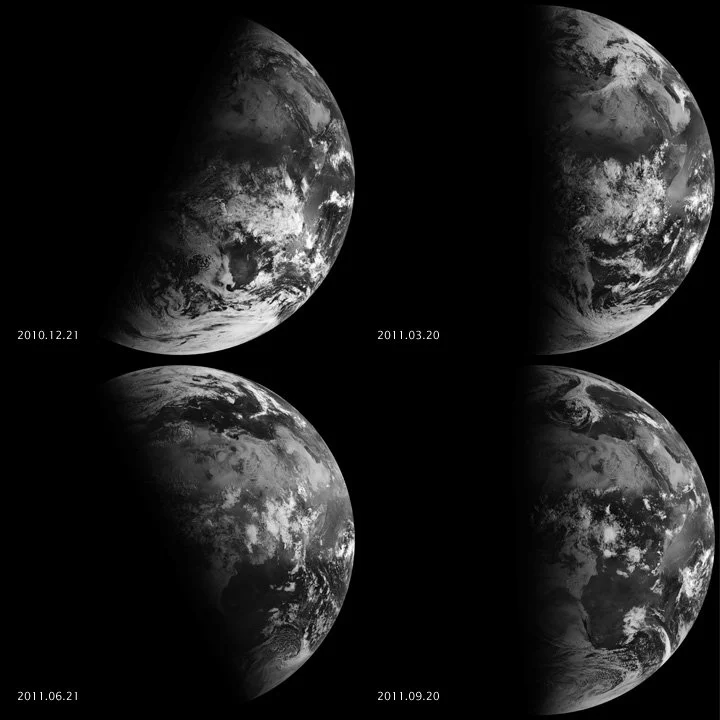
Earth’s day-night boundary shifts throughout the year as the planet’s tilted axis changes its orientation toward the Sun. These satellite views show how the terminator changes between the solstices and equinoxes.
IMAGE COURTESY NASA/ROBERT SIMMON, USING EUMETSAT DATA
While other places may experience crisp air and changing leaves during fall, in South Texas, the season shift is subtler. Here, fall is marked by shifting shadows and earlier sunsets brought by a cosmic balance that happens twice a year, with the autumnal equinox taking place Tuesday, Sept. 22.
This, however, is not an all-day event. In the Rio Grande Valley, the equinox will occur at 7:05 p.m. At this moment, the sun will cross the celestial equator from north to south, marking the beginning of astronomical fall in the Northern Hemisphere.
This happens because Earth doesn't sit perfectly upright – its axis is tilted at about a 23.5-degree angle. Think of Earth as a tilted spinning top maintaining the same general orientation as it travels around the sun. During the solstices, one hemisphere is tilted toward the sun while the other is tilted away. During an equinox, however, Earth's axis is tilted neither toward nor away from the sun, allowing both hemispheres to receive nearly equal amounts of sunlight.
The word equinox comes from two Latin words: aequus, meaning “equal,” and nox, meaning “night.” The equinox doesn't exactly give us equal night and day though.
According to Sky & Telescope, having exactly 12 hours of night and day is tricky. Several factors come into play. The National Weather Service states that Earth's atmosphere acts like a lens, bending sunlight around the horizon. Because of this atmospheric refraction, we can see the sun for a few minutes before it geometrically rises above the horizon and after it falls below it.
The way sunrise and sunset are measured also adds daylight, meaning the equinox does not produce exactly equal amounts of day and night. Equal day and night do occur, but the date varies depending on latitude and does not necessarily fall on the equinox.
According to Time and Date, the Rio Grande Valley will receive roughly 12 hours and 8 minutes of daylight on the equinox. The RGV will likely experience equal night and day around Sept. 25 or 26.
The equinox is not just the endpoint of summer – it's the kickoff to longer nights. And with longer nights come more opportunities for skywatching. So, mark your calendars for Sept. 22, soak in the final extra minutes of summer light and keep your eyes to the sky.