NASA's Roman Space Telescope set for launch in August
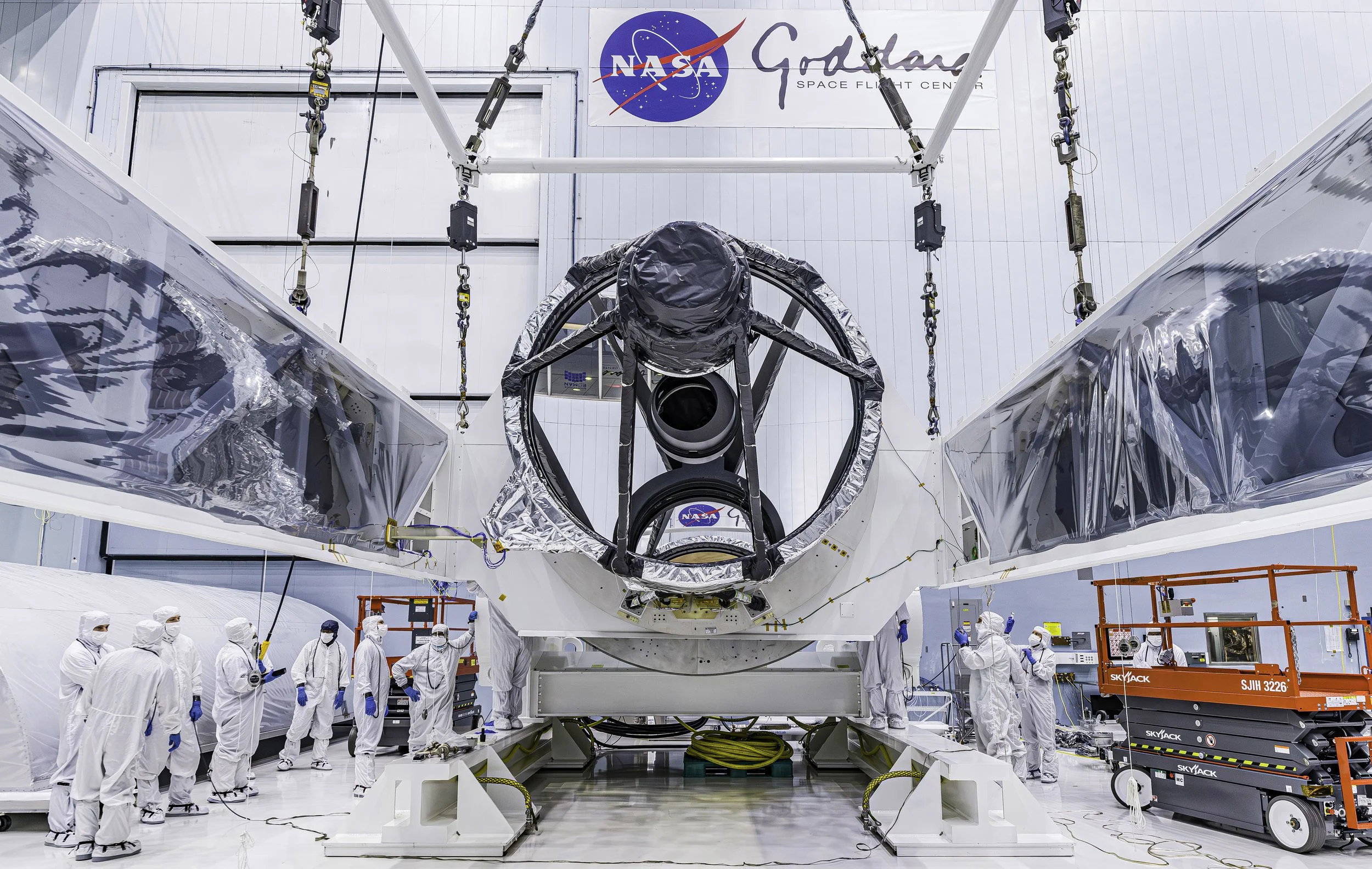
The Optical Telescope Assembly for NASA's Nancy Grace Roman Space Telescope is shown inside the agency's largest clean room at NASA's Goddard Space Flight Center in Greenbelt, Maryland. The observatory recently completed major testing and is scheduled to launch Aug. 30, 2026.
PHOTO COURTESY NASA/CHRISS GUNN
NASA's Nancy Grace Roman Space Telescope is scheduled to launch from Kennedy Space Center on Aug. 30, 2026, beginning a mission to investigate dark matter, dark energy and thousands of planets beyond the solar system.
The announcement came after the observatory completed construction, testing and prelaunch milestones nine months ahead of schedule.
Roman will combine a wide field of view with infrared imaging, allowing it to capture areas of the sky at least 100 times larger than the Hubble Space Telescope in a single observation while maintaining comparable image quality.
Scientists plan to use this telescope to investigate some of astronomy's biggest questions, including the nature of dark matter, dark energy and formation of galaxies. "Roman is poised to conduct revolutionary surveys that will impact every area of astronomy," said Julie McEnery, Roman's senior project scientist at NASA's Goddard Space Flight Center.
The telescope will also conduct one of the largest infrared sky surveys ever attempted and is expected to discover thousands of new exoplanets. McEnery said the observatory's wide field of view will dramatically increase the pace of astronomical research, noting one month of Roman observations would take about a century with the Hubble Space Telescope.
Those surveys are expected to reveal how the universe has expanded over billions of years.
By measuring the distribution of galaxies, distant supernovas and effects of gravity across the cosmos, Roman will help scientists study dark energy, a mysterious force believed to drive the universe's accelerating expansion.
Beyond cosmology, the telescope will also search for thousands of planets orbiting distant stars using gravitational microlensing.
Wendy Mendoza, a physics and astronomy doctoral candidate at The University of Texas Rio Grande Valley, said Roman's greatest strength is its ability to observe much larger areas of the sky at once.
"If you see one image of Hubble that you see online, Roman is going to observe it much more in a panoramic photo," Mendoza said. "We're going to see not just one part of a nebula, we're going to see the whole entire image."
While Hubble excels at capturing detailed views of individual objects, Roman will allow astronomers to observe much larger sections of the sky without sacrificing image quality, making large-scale surveys significantly faster.
"As more telescopes become available, the better we understand what is happening in our universe," Mendoza said. "There's going to be more datasets that's going to lead to more unexpected discoveries."
Roman will join NASA's fleet of flagship observatories alongside the Hubble and James Webb space telescopes, giving astronomers the ability to study the universe using complementary instruments and wavelengths.
Looking beyond Roman, NASA is developing the Habitable Worlds Observatory, a next-generation flagship mission currently targeted for the 2040s. Until then, Roman is expected to provide discoveries which will shape the future of astronomy.
McEnery said Roman's greatest discoveries may be the ones scientists have yet to imagine.
"The most exciting things from Roman will be a surprise, something that we couldn't predict," she said.