
The dog days are over
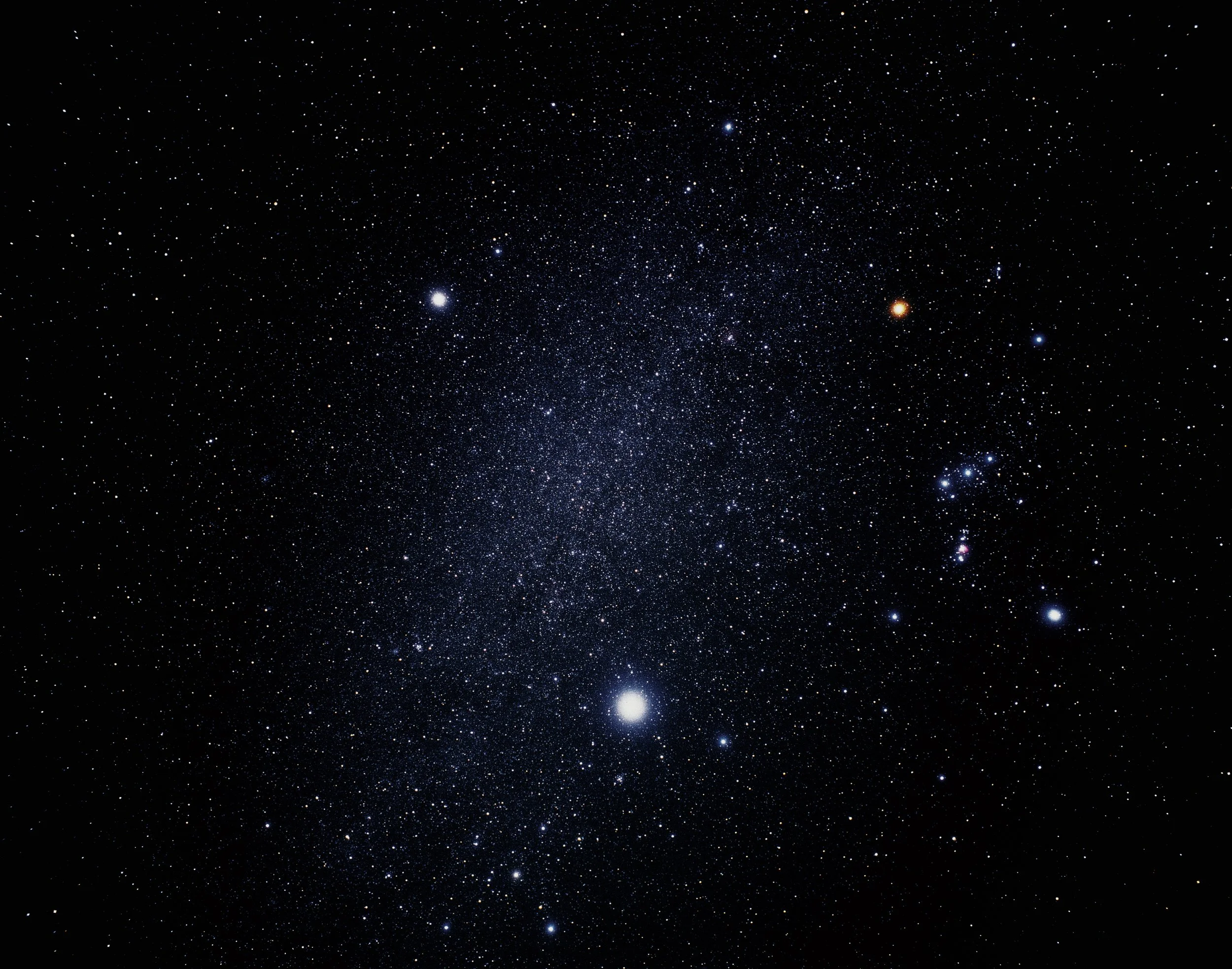
Orion and his two celestial companions, Canis Major and Canis Minor, shine together in the night sky. Canis Major is home to Sirius, the brightest star in Earth’s night sky.
IMAGE COURTESY AKIRA FUJII/ESA/HUBBLE
“The Dog Days Are Over” is one of Florence + the Machine’s best-known songs, and it is about overcoming difficulties and leaving bad moments behind. Believe it or not, astronomy is involved in all of this.
Let’s begin with Orion, the Hunter. Orion is one of the easiest constellations to identify in the night sky, but his faithful companions may be less familiar. In Greek mythology, Orion is accompanied by two dogs represented in the sky by the constellations Canis Major, the Greater Dog, and Canis Minor, the Lesser Dog.
Canis Major is home to Sirius, the brightest star in Earth’s night sky. Sirius is relatively close to us at about 8.6 light-years away. It is actually a binary star system consisting of a blue-white main-sequence star, Sirius A, and a small white dwarf, Sirius B, orbiting each other.
What does any of this have to do with overcoming challenges in life? Well, that is where the “dog days” come in.
About 2,000 years ago, Sirius would become visible around dawn during the hottest part of the summer. Ancient Greeks and Romans associated the appearance of Sirius, sometimes called the Dog Star because of its place in Canis Major, with the season’s intense heat. They believed its light added to the Sun’s heat, contributing to the hottest days of the year.
That association gave us the expression “dog days of summer.”
As autumn approaches, summer begins to give way to a new season, and the traditional dog days come to an end. The astronomical connection even appears in Florence + the Machine’s “Dog Days Are Over” music video, where Canis Major is depicted as part of the animation.
The official dog days may be over, but here in the Rio Grande Valley, summer temperatures tend to stick around. We will probably have a few more weeks which certainly feel like dog days.
There is one more interesting piece of this story. The relationship between Sirius and the Sun in our sky does not remain perfectly fixed over thousands of years. Earth’s axial precession, along with the motion of stars through the galaxy, gradually changes when stars and constellations appear in our sky.
The sky is always changing, even if those changes happen far too slowly for us to notice from one summer to the next.
So, while Florence + the Machine may tell us the dog days are over, the stars remind us that nothing in the sky stays exactly the same forever.
