The star that refused to explode
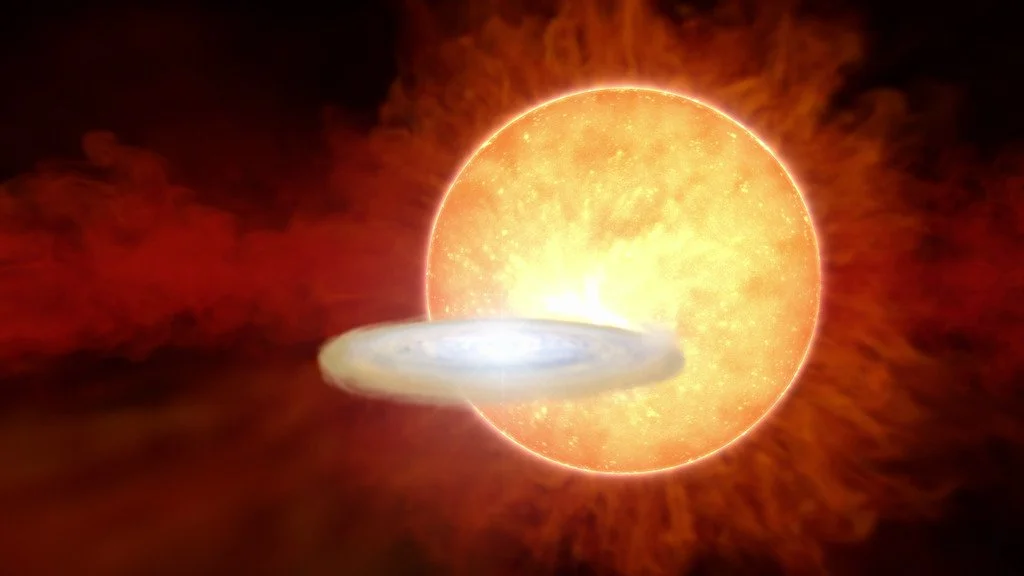
Located 3,000 light-years away, T Coronae Borealis — T CrB for short — contains two stars that orbit each other: a red giant nearing the end of its life and an Earth-sized stellar remnant known as a white dwarf. The dwarf’s intense gravity rounds up some of the gas flowing off of the red giant, forming a flattened cloud of gas around the dwarf — an accretion disk. Gas in the disk gradually works its way inward, eventually flowing onto the white dwarf nestled at its center.
PHOTO COURTESY NASA’S GODDARD SPACE FLIGHT CENTER CONCEPTUAL IMAGE LAB
What happens when astronomers around the world are waiting for a star to explode, but the star just doesn’t cooperate?
This question is what drew me to T Coronae Borealis, or T CrB, also known as the Blaze Star.
About 3,000 light-years away, T CrB is actually a system of two stars: a red giant and a white dwarf. According to NASA, the white dwarf pulls material from its companion through a process called accretion. Over time, hydrogen-rich material builds up on the white dwarf until the pressure and temperature become high enough to trigger a thermonuclear eruption known as a nova.
I came across T CrB while looking for an astronomy topic to research. I wanted to study something I could actually observe instead of analyzing an event which had already occurred. T CrB was perfect because astronomers were waiting for it to erupt again.
Unlike a supernova, which can mark the explosive death of a star, a nova does not destroy the white dwarf. The white dwarf survives, allowing the process to eventually happen again.
T CrB erupted in 1866 and 1946. Research published in The Astrophysical Journal Supplement Series documents the long-term history of T CrB and other recurrent novae. In 2024, NASA reported T CrB’s recent behavior appeared similar to what astronomers observed before its 1946 eruption.
However, predicting exactly when the next nova will occur remains difficult. The roughly 80-year interval between previous eruptions is not a countdown. The timing depends on complex processes, including how material moves between the stars and accumulates on the white dwarf.
So, I started watching.
I observed T CrB through different filters and plotted its brightness over time to create light curves. A light curve is a graph showing how an astronomical object’s brightness changes over time. Its rises, dips and fluctuations can provide clues about changes occurring within the system.
But my light curve did not show what I was waiting for.
It instead showed small fluctuations in brightness but no clear upward trend, suggesting an imminent nova during my observation period. Instead of seeing the dramatic change I expected, this relative stability raised a more interesting question:
What subtle patterns might occur before a nova, and could a neural network help identify them across years of data?
As I continued analyzing my observations, astronomers around the world continued watching T CrB as well. The anticipated eruption did not arrive in 2024. Then 2025 passed. The wait continued into 2026.
That changed my question from, “When will it erupt?” to, “What are we missing?”
The continued wait shows the limits of relying on historical patterns. Previous eruptions provide valuable clues, but they cannot tell us exactly when the next one will occur.
Could a neural network find the pattern?
That uncertainty led me to the next part of my research: Could a neural network recognize changes in a nova that we might miss by looking at individual graphs?
My idea is to train a neural network, a type of machine-learning model, using decades of archived observations of T CrB and, eventually, expand the model to include data from other recurrent novae.
Instead of looking only for one large increase in brightness, the network could analyze many measurements together, including changes in brightness, color, variability and patterns developing over time. Additional data from spectroscopy and ultraviolet and X-ray observations could give the model more information to identify potential patterns.
The goal would not be to predict an exact eruption date. With limited data from past recurrent nova eruptions, my goal is not to predict an exact eruption date. Instead, I want to explore whether a neural network could recognize unusual combinations of changes and identify when a nova system begins behaving differently from its normal state.
Rather than telling us exactly when T CrB will erupt, perhaps it could tell us when we should pay closer attention.
My research did not end with the explosion I hoped to see. Instead, it left me with another question and reason to keep watching.
I am still following T CrB alongside astronomers around the world. Whether it erupts tomorrow or makes us wait longer, every new observation gives us another piece of the puzzle.
This is what T CrB taught me about astronomy: Sometimes discovery comes from continuing to observe even when the universe doesn’t do what we expect.