From the RGV to the cosmos: when the universe speaks
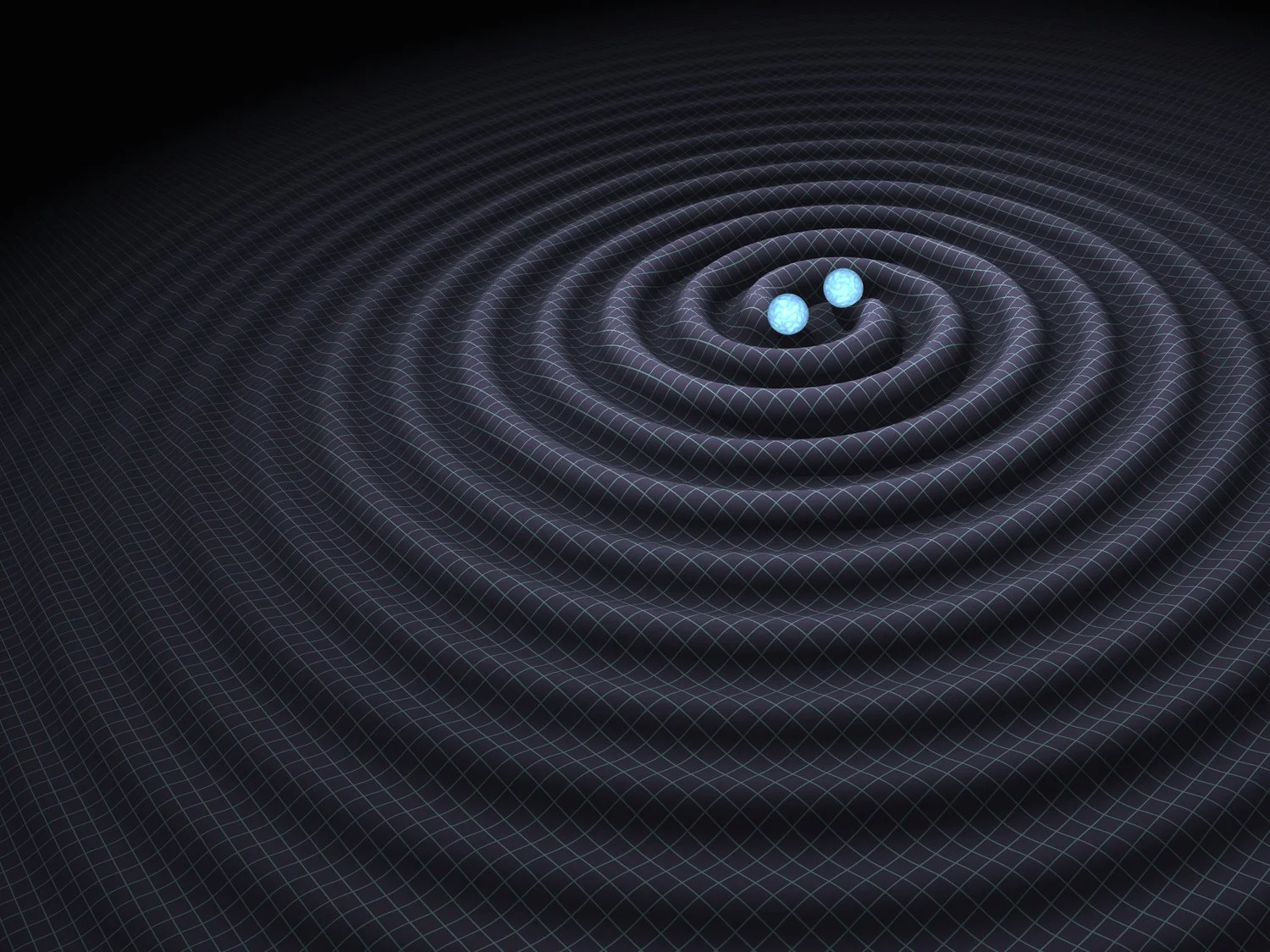
Two black holes spiral toward one another before merging, sending gravitational waves rippling outward through spacetime.
IMAGE COURTESY R. HURT/CALTECH-IPAC
The universe can tell us its secrets if we know how to listen.
Think of the ripples on the surface of a pond after you drop a pebble into it. In the universe, massive objects such as neutron stars and black holes can create something similar: ripples in spacetime called gravitational waves.
When massive objects accelerate, such as two neutron stars or black holes spiraling around one another and eventually merging, they disturb spacetime. Those disturbances travel outward at the speed of light as gravitational waves.
Why study them? Gravitational-wave detections allow us to gather new information about the universe’s most exotic objects and cataclysmic events, from merging black holes and neutron stars to potential signals from core-collapse supernovae and starquakes.
When two neutron stars collide, for example, the resulting explosion can produce heavy elements, like gold. Researchers at MIT estimated that a binary neutron star merger detected in 2017 may have produced several Earth masses worth of gold.
First predicted by Albert Einstein in 1916 following his theory of general relativity, gravitational waves give astronomers a new way to study the universe. By analyzing their waveforms, researchers can learn about properties of black holes and neutron stars, including their masses, spins and orbital dynamics.
Unlike electromagnetic radiation, such as visible and infrared light observed by telescopes like the Hubble Space Telescope and the James Webb Space Telescope, gravitational waves interact weakly with matter. They can travel across the universe largely undisturbed, carrying information about events which may be difficult or impossible to observe using light alone.
For decades, however, detecting them remained beyond scientists’ reach.
Detecting gravitational waves requires extraordinary precise equipment, careful calibration, and sophisticated data analyses. Decades of technological development and international collaboration eventually led to the construction of massive observatories, including two Laser Interferometer Gravitational-Wave Observatory, or LIGO, detectors in the United States, Virgo in Italy and KAGRA in Japan.
In 2015, LIGO made the first direct detection of gravitational waves, observing a signal produced by the merger of two black holes more than a billion light-years away.
These observatories use a technique called laser interferometry. A laser beam is split into two beams that travel down long, perpendicular arms. Mirrors at the ends of the arms reflect the light back toward the point where the beams originated.
When a gravitational wave passes through Earth, it stretches spacetime in one direction while compressing it in another. The change is extraordinarily small, but it slightly alters the distance traveled by the light in each arm. When the beams return and recombine, researchers can measure the resulting change in their interference pattern.
A signal detected at multiple observatories can then be compared and analyzed to help determine where it came from and what produced it. One famous example is GW170817, the 2017 merger of two neutron stars observed through both gravitational waves and electromagnetic radiation.
LIGO consists of two L-shaped detectors 3,000 kilometers apart, one in Hanford, Washington, and another in Livingston, Louisiana. Each observatory has two 4 kilometer arms.
Their extraordinary sensitivity also presents a challenge: researchers must distinguish gravitational waves from vibrations and other environmental noise. In a 2008 paper, UTRGV professor Teviet Creighton examined how aircraft passing near a detector could create signals that might interfere with observations, demonstrating the importance of identifying and filtering environmental noise.
Across the Atlantic, Virgo operates near Pisa, Italy. Like LIGO, the Virgo detector uses perpendicular arms, each 3 kilometers long, and measures changes in the interference pattern of laser beams traveling through them.
Japan’s KAGRA detector has two 3-kilometers arms, but its design introduces two major differences. The observatory is built about 200 meters underground to help reduce seismic and human-made noise, and its mirrors are cooled to cryogenic temperatures to reduce thermal noise.
Building and operating these observatories is no small task. Detecting gravitational waves requires not only enormous instruments but also the algorithms used to identify, process and analyze incredibly faint signals hidden within noisy data. That work depends on collaboration among researchers around the world.
South Texas has been part of that effort for decades.
The South Texas Space Science Institute (STSSI) at UTRGV traces its involvement in gravitational-wave research to the 1990s. Faculty and students from UT Brownsville, and later UTRGV’s Brownsville campus, have contributed to LIGO research and the broader international effort to understand the gravitational-wave universe.
UTRGV researchers were also among the scientists involved in studying GW170817, the first gravitational-wave detection from a binary neutron star merger.
From massive detectors thousands of miles apart to researchers working here in the Rio Grande Valley, listening to the universe is an international effort. And every new signal gives scientists another opportunity to uncover secrets that, until recently, the universe had kept hidden.