
The Physics of the Sun
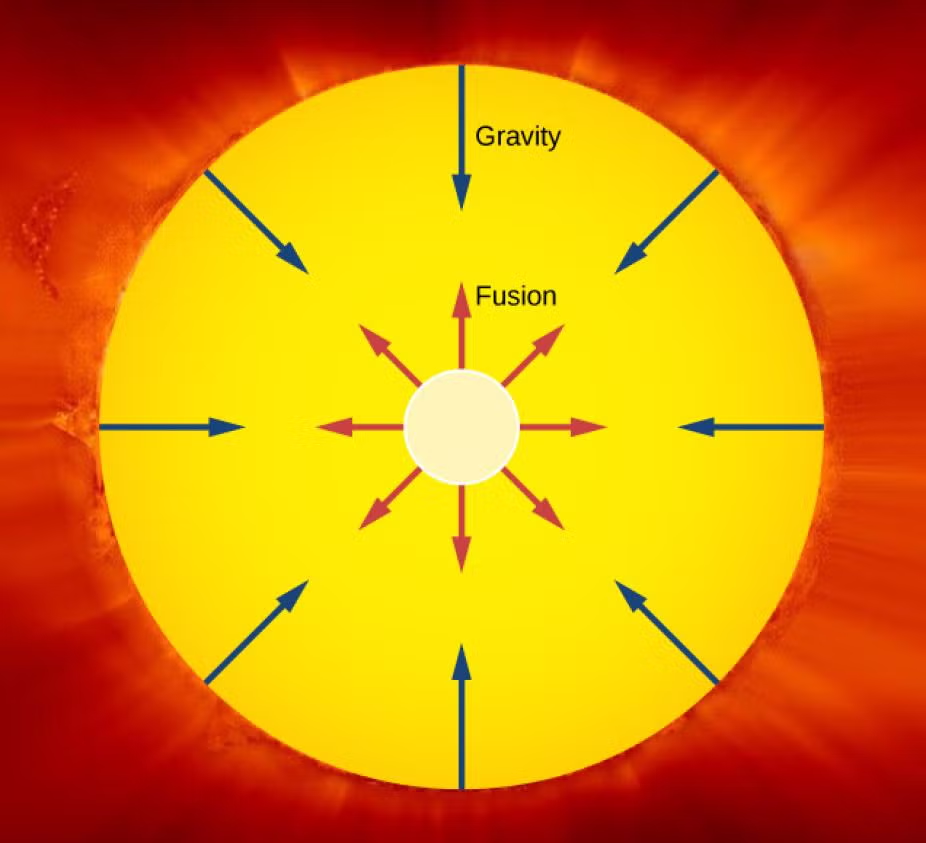
Image courtesy: Physics LibreTexts
The Sun is not burning the way fire does; it is powered by continuous nuclear fusion. Since grade school, students are taught the Sun converts hydrogen into helium. However, much more is happening inside the Sun than most students learn.
The Sun is a natural thermonuclear reactor that fuses elements within its core. The Sun remains stable because gravity pulling inward is balanced by the outward pressure produced by nuclear fusion. Nuclear fusion occurs under the extreme temperatures and pressures needed to overcome the electrostatic repulsion between hydrogen nuclei. When the core becomes hot and dense enough, nuclear fusion begins, marking the birth of a star.
Referencing the periodic table, hydrogen has an atomic number of 1 and helium has an atomic mass of about 4. How is it possible that tiny hydrogen atoms eventually become helium? Isotopes, the answer is isotopes! Isotopes are atoms of the same element that contain the same number of protons but different numbers of neutrons. Neutrons do not carry an electrical charge; they only provide additional mass. The hydrogen isotopes involved in this process include hydrogen-1 (¹H), called protium; hydrogen-2 (²H), called deuterium; and hydrogen-3 (³H), called tritium. These hydrogen isotopes are intermediate products that allow fusion to continue until helium is formed.
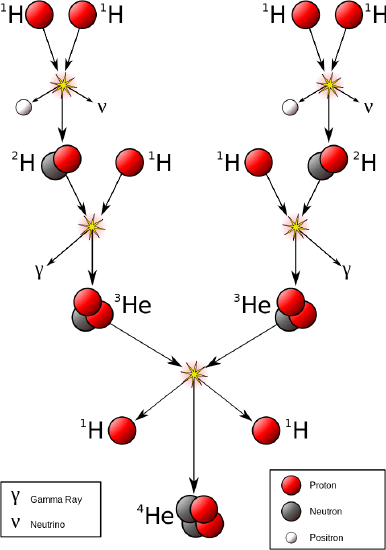
Image courtesy: Wikimedia Commons
The extreme pressure and temperature at the Sun's core allow two hydrogen nuclei to fuse, forming hydrogen-2. This process releases energy in the form of radiation and subatomic particles. Deuterium can fuse with protium to produce helium-3. Two helium-3 atoms can then fuse to form one helium atom while releasing two hydrogen nuclei. Each of these reactions releases subatomic particles and radiation.
Once the fusion reaction starts, the material in the star will react, igniting a new star. The duration of the fusion reaction depends on the star's mass, which will define its life cycle. Helium is just one step in a star's evolution; more complex reactions will occur at the end of a star’s life.
During stellar nucleosynthesis, heavier stars begin fusing heavier elements. Once hydrogen fusion in the core comes to an end, helium fusion begins. Successive fusion reactions create heavier elements. While the Sun only has enough mass to produce carbon and some oxygen through helium fusion, more massive stars can continue fusing heavier elements until they eventually produce iron. Since fusing iron requires more energy than it releases, it is impossible for a star to generate more energy through additional fusion.
Remember when it was mentioned that stars are in equilibrium between gravity and fusion? When a star can no longer sustain fusion, gravity takes over and wins. It always wins. The star collapses under its own gravity. Depending on the star’s original mass, the remains may transform into a planetary nebula surrounding a white dwarf or explode into a supernova, leaving behind a neutron star or black hole.
The life cycle of stars and the formation of different elements can be understood with the physics of the Sun. This is how the universe reinvents itself.
For more information, visit https://science.nasa.gov/sun/facts/ or https://science.nasa.gov/universe/stars/.
