
We Are Missing One!
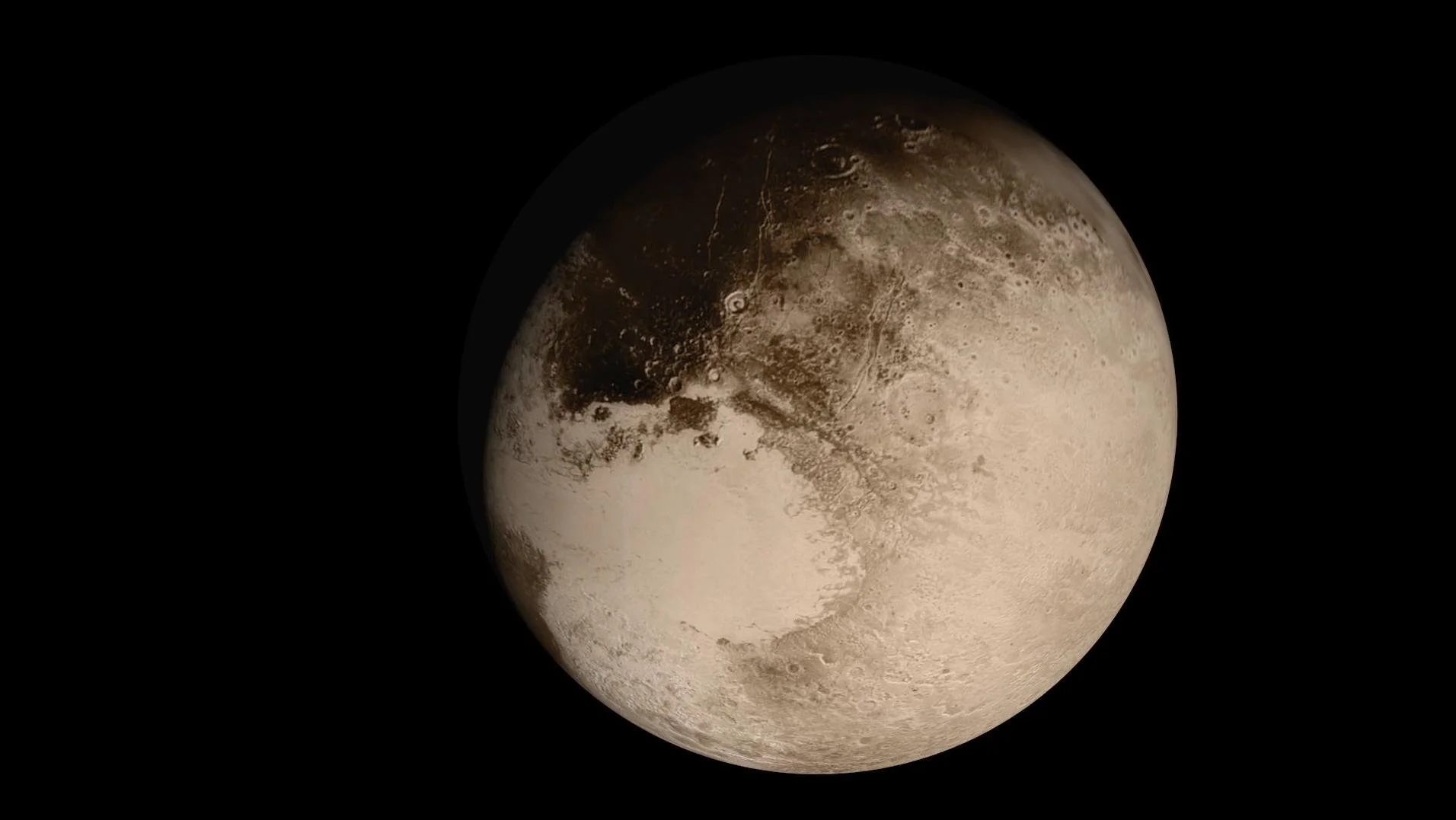
Image: NASA
Some of us are old enough to remember we used to have nine planets in our solar system, but in 2006, the International Astronomical Union (IAU) reclassified Pluto as a dwarf planet.
The resolution the IAU passed defined three requirements planets must fulfill:
It must orbit around the sun: Check!
It must have enough mass to be spherical: Check!
It must have “cleared the neighborhood” around its orbit: This is where Pluto fails.
Pluto orbits the sun inside the Kuiper Belt, a donut-shaped area that contains the remains of material that was not integrated into a planet. Think about it as the leftovers from the building materials of the remaining eight planets that could not form a larger planetary structure.
Pluto cannot clear the neighboring objects in its orbit because it does not have enough gravitational pull to sweep up, eject or control the debris around it. In fact, our moon is bigger than Pluto. For comparison, Pluto’s diameter is only about two-thirds the size of the moon.
This is why Pluto is considered part of a new category: a dwarf planet. Pluto is not the only known dwarf planet that has been discovered. There are four other recognized dwarf planets: Ceres, Eris, Haumea and Makemake. Only Ceres is in the main asteroid belt between Mars and Jupiter and not in the Kuiper Belt.
Losing Pluto as a planet was a shock for many of us, but when we study the facts, we can reluctantly understand why it is now classified as a dwarf planet. It was not the decision of a single astronomer (I’m looking at you, Neil!), but rather the consensus of the astronomical community.
Pluto will exist in our collective knowledge as the dwarf planet that was once a planet, but at least it departed fighting back with the biggest heart on a planetary surface.
For more information about Pluto you can visit https://science.nasa.gov/dwarf-planets/pluto/ to learn more.
