
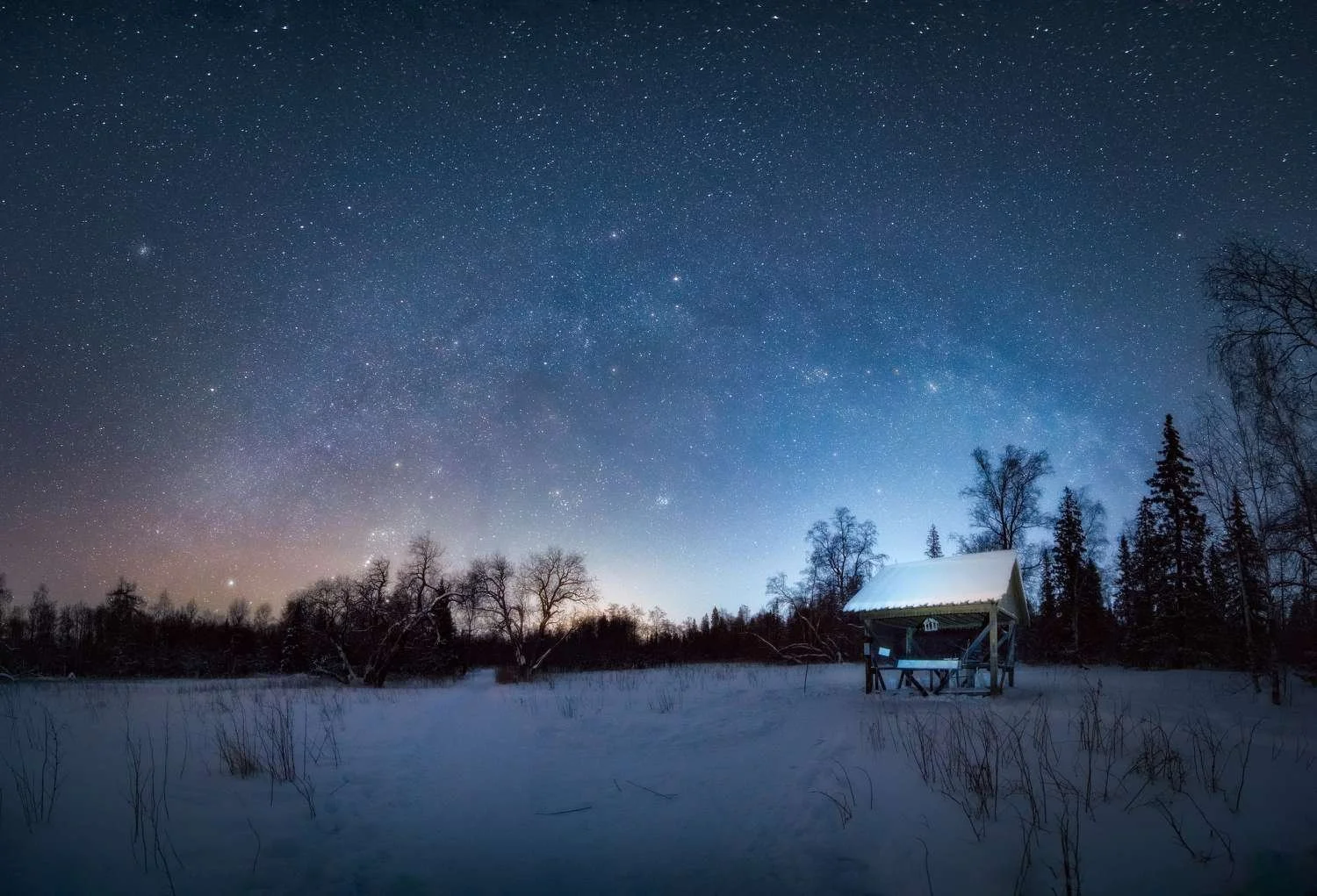
Image source: Treehugger
December Sky
Did you catch a glimpse of any Geminid meteors last weekend? A star-gazing teacher friend, Lucero, caught a few with her camera. She saw 8, which is a good number, given the clouds and light pollution in our area. The meteors seem to streak from the constellation Gemini, rising in the east, well up in the sky my ten o’clock PM. Gemini’s brightest stars are brothers in Roman and Greek mythology, Castor and Pollux, that mark the heads of the twins. The feet of the group extend to the far right above Orion’s head and Betelgeuse. The constellations would make more sense if you read those ancient myths.
The winter solstice occurs Sunday, the 21, marking the official beginning of winter. Another year is winding down, a new one waiting in the wings. Planet Earth is wending its way around the Sun in its never-ending cycle of revolving around the Sun while the entire solar system is tucked away in an outer spiral arm rotating about the center of the Milky Way galaxy. We are in the last seasonal quarter of a year. That certainly puts things in perspective; who are we earthlings, anyway, in the grand scheme of things?
Ancient Celts and many other cultures recognized the solar motion along the horizon and kept track of the changes of the sun’s position throughout the year as it rose and set. There was fear that the sun might not return and so the longest night of the year was widely celebrated. As Christian missionaries arrived in those places from the Bible lands, they merged many Christian celebrations into the pagan ones, which is why we today celebrate Christmas in the dark winter months- calling the sun back into the sky-connecting with the joy and light of Christ’s birth. Most of us celebrate something during this month and feel the joy of being with friends and family, good co-workers, and even complete strangers in stores as we call out the traditional greetings. Lots of folks have opted for happy holidays to cover all bases, but the real greeting referred to holy days, so that does add a different perspective. Words meanings do alter understanding, but their meanings may change over time.
December is the birth month of the great naked-eye observing Danish astronomer in the sixteenth century, Tycho Brahe. His interest in astronomy was sparked by his seeing a solar eclipse occur on the day it was predicted to occur. His observatory was on an island near Hamlet’s castle of Elsinore. He was honored to be the protégé of the king of Denmark. Aside from being famous for his work in astronomy, Brahe is remembered for his silver nose, created for him after he lost his own flesh and blood nose in a sword fight. Any self-respecting man took up a sword to fight the insulter over even simple insults in that day. It’s a good thing that is not done today. He was a careful observer and accurately mapped over 700 stars. If you have looked at the Moon through binoculars or a telescope you have seen the crater named after him.
By 7:00 P. M. Orion is rising straight up from the eastern horizon, with the three belt stars Alnitak, Alnilam, and Mintaka, almost in a vertical line with ruby-red Betelgeuse in Orion's right shoulder (as he faces you) and blue-white Rigel in his left knee standing post on either side of the trio of stars.
Surrounding Orion are his compadres, both animal and human. The dogs are Canis Major and Minor, the humans are the Gemini Twins, and Auriga the Charioteer. The team is chasing Taurus the Bull that is running away with the Seven Sisters on his back. Together they are called the Winter Circle asterism.
The stars of Canis Major are beautiful. The brightest star in the group is named Sirius, the Dog Star. This magnificent specimen is the standardized measure of the brightness, or magnitude, of all other stars. It radiates all the colors of the spectrum as it spends the night seeming to move from east, to south, to west in a graceful arc. If you see it, you will not forget it. Sirius is a point of a vertex of a triangle marked by two much less bright stars above it that mark the dog’s head. There is a triangle of stars below Sirius that mark the front legs, and a right triangle about a fist width from Sirius that marks the hind legs and tail. Of course, Canis Major is a Pointer with her tail extended out straight behind her.
Her pup, Canis Minor is shaped almost like the Greek symbol delta, l, located above Canis Minor and below the rectangle of Gemini. Only Procyon is very bright in this constellation, so the group resembles a hotdog.
The Charioteer Auriga is shaped like a pentagon with a small faint isosceles triangle to the right edge. The triangle is two young goat kids. The brightest star in Auriga is named Capella.
Merry Christmas to you and yours and remember to keep looking up.
