
the autumn equinox: how space shapes Our seasons
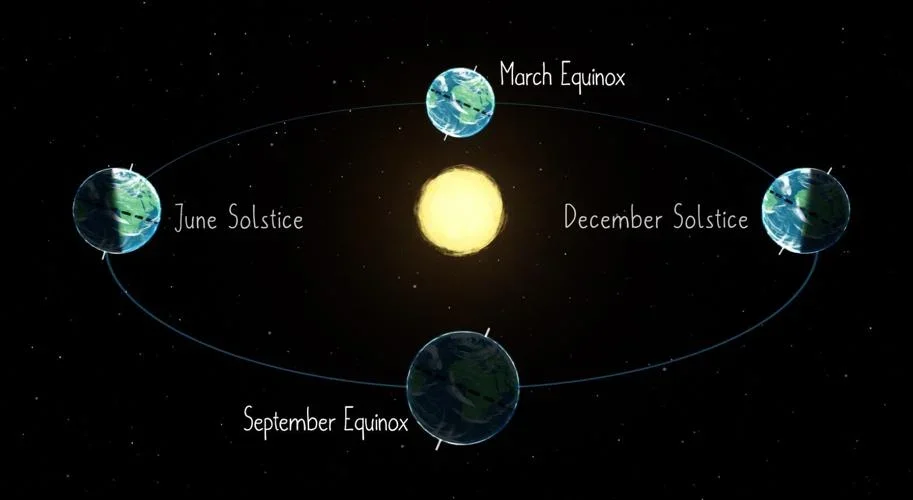
Image: NASA
Behold the Autumn Equinox, a moment in the cosmic dance where Earth’s orbit aligns the Sun directly above the equator, balancing day and night and ushering in fall’s cooler seasons. But what is an equinox? And what is an orbit? We all know the solstices, the longest day of the year around June 20–21, the Summer Solstice, and the shortest around December 20–21, the Winter Solstice. At these times, we experience extreme shifts in the amount of sunlight each day. Have you ever wondered which day of the year has nearly equal daylight and darkness? If you guessed “equinox,” you’re correct.
On Sept. 22, the cosmos delivers a near-perfect balance of light and shadow, with day and night as equals. We call this shift the transition from summer to fall, often forgetting it is caused by Earth’s position in space. Did you know many of the ways we keep time are rooted in cosmic phenomena?
A day is based on Earth’s rotation. A sidereal day, when Earth completes one full rotation on its axis relative to distant stars, lasts 23 hours, 56 minutes and 4 seconds. For simplicity, we use a 24-hour solar day. A month is inspired by the Moon, which takes about 27.32 days to orbit Earth, shaping early lunar calendars that influenced the ones we use today. A year comes from Earth’s orbit around the Sun every 365.24 days, while our planet’s tilted axis creates the changing seasons. In a way, “Happy Birthday” could also mean “Happy Orbit Day.”
Seasons themselves are framed by solstices and equinoxes, with spring, summer, fall and winter tied to Earth’s tilted rotation and changing relationship to the Sun. Equinoxes and solstices spark wonder, reminding us of Earth’s endless dance through space in a cosmic rhythm that shapes our world.
In the Northern Hemisphere, the autumn equinox signals a gentle descent into fall’s cooler, reflective days, while in the Southern Hemisphere it awakens the vibrance of spring. These celestial events reveal how deeply space governs our timekeeping, with days measured by Earth’s rotation, months inspired by the Moon’s orbit and years defined by our journey around the Sun. By celebrating these moments, we reconnect with the Universe’s vast influence on our calendars and our lives.