
Stars in the Milky Way
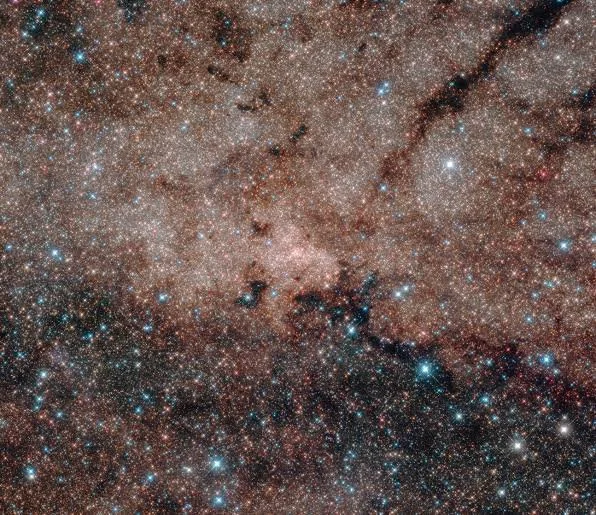
Image: NASA
It has been so unbearably hot these past several weeks that it hardly seems possible we are moving into another season in a few weeks. As we move closer to the autumn season the Great Square of Pegasus will be well up in the sky by ten o'clock, rising from the east and trekking slowly across the southern sky ‘as the world turns’ until dawn when it will be sinking in the west. This massive constellation occupies many degrees of sky. Have you been aware that the math for measuring constellations is similar to measuring distances on the surface of earth?
If you have a dark site and decent binoculars you can sweep the sky slowly and see the Milky Way stars stretched from northeast to south as they arc across the zenith, shedding their milky appearance on sky watchers below. Some folks told a story that those stars are the result of a heavenly cow kicking over a bucket of milk; today our skies are so light polluted it is more likely a story would be told we are trying to see the sky through a dusty windshield. Somehow, I prefer the cow in the barn story.
Within the Milky Way stars, from south to northeast, are the constellations of Sagittarius, Aquila, Cygnus, Lacerta (Lizard), including part of King Cepheus, and his consort, Queen Cassiopeia. Most people have an app on their cell phones now to reveal the locations of these constellations and other astronomical objects. Those are a far cry from the star maps I used when I first learned how to find my way around the sky. It might interest you to explore the ancient star maps available to us on online sites. There is some beautiful and strange artwork associated with astronomy-from indigenous rock art to delicate work on animal skins.
By now we know if the Nancy Grace Roman telescope was successfully launched into space. The technology behind the various tools the nations have launched into space to study ‘what is out there’ is incredible. Imagine the strides made by scientists of many space-faring nations that have been made just in the past fifty years-from twelve American astronauts walking on the lunar surface, the missions to the various planets, the satellites that mapped the ocean depths and the space-based telescopes that have revealed unimaginable conglomerations of gasses and dust that have hidden secrets from human eyes for millennia-and known now because of math and human ingenuity plus a few trillion dollars from we the people. WOW.
If that statement bothers you, be sure to go to the internet and take a look at how spin-offs from just our space initiatives benefit us every single day, saving lives or just giving us something useful in our everyday living. Does it amaze you to think the computer in your watch has more capabilities than the auditorium-sized computer that was used to send Neal Armstrong to the Moon? https://spinoff.nasa.gov
Reflecting on the view of the little Teapot asterism in Sagittarius, keep in mind that when you are looking at this Milky Way constellation you are looking into the center of our galaxy which is about 26, 000 light years away, and hidden behind thick clouds of dust.
I hope this is giving you impetus to go take a walk and look up. Enjoy the beauty of the nighttime and predawn skies; share the experience with someone special. Until next week, do let some stars get in your eyes. carolutsinger@att.net
