
Roman Telescope, Observe the Moon Night, & More!
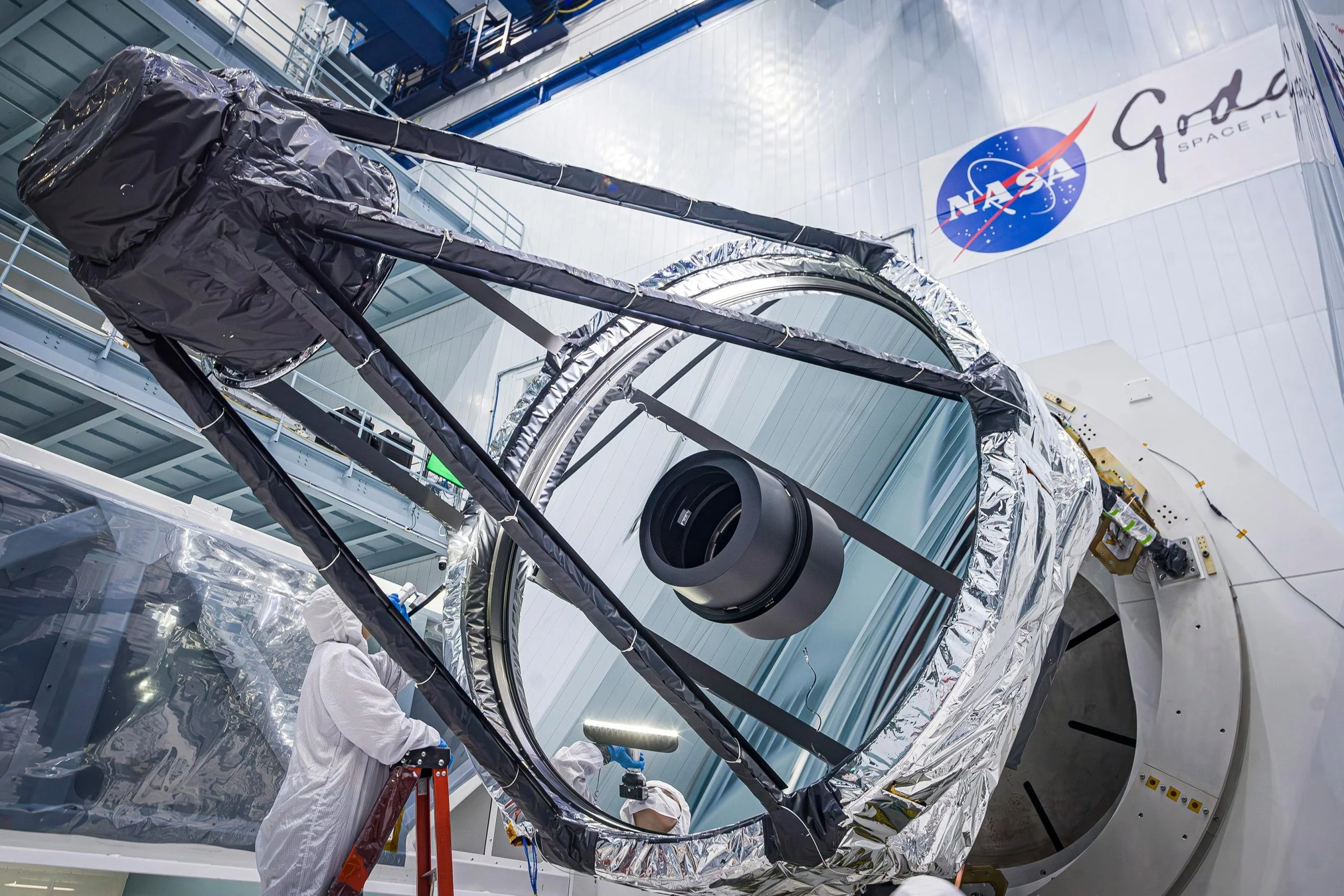
Image: SciTech Daily
Ready, set, just a few more weeks and autumn will arrive, and our typical back to school rains have yet to bring relief from scorching daytime starshine. It is a good thing our home is in the Goldilocks zone of Old Sol. Not too close; not too far; just right. Although it has seemed to be lots more too hot for comfort. At least this means we are almost three-fourths of the way around the Sun now and may expect cooler temperatures due to our planet’s tilt.
The well-publicized launch of the Nancy Grace Roman Telescope this past Sunday morning was a success and scientists expect it to reach is special place in space during late November or early December. The stunning images shared by the various space-based telescopes have opened incredible sights, much to astronomers’ delight. It is expected this newest one will bring more details. Logging on the https://science.nasa.gov site will provide you with detailed information about this “new and improved” version of our eye on the sky.
The South Texas Astronomical Society and the Southmost Branch Library are collaborating on an event for the official Observe the Moon night September 19; it is tentatively set to begin at 7:00 PM and end at 9:00 PM. The plan is to have multiple telescopes available, even if the observatory telescope is not available. As always, the events at the library are free and family friendly and include activities and astronomy ‘how it came to be’ stories.
If you have been keeping track of Venus over the past months you are aware that it is sinking into the western horizon, following the Sun, by the end of twilight. By the end of October, it will be in the morning sky for early risers to welcome. The dance of the planets is such an engaging free activity to enjoy and with Venus leaving we will begin to see Saturn rising in the night sky in the east. Those rings of Saturn that puzzled the early astronomers are a glorious sight to see through a telescope. If you have never had the pleasure of observing them through a really good telescope, you don’t know what you have missed. It would be great if all the schools had decent telescopes and were able to sponsor nights out on the campus grounds the way we once were able to experience at one of Brownsville’s middle school campuses in 2004. If you are an educator perhaps you might consider beginning something like a star-gazing night for your campus families. The one that was offered here had about a hundred teens involved and when a viewing event was held a thousand folks came throughout the time of the event.
With a group in Harlingen in the beginning planning stage and hoping for an official Dark Skies initiative, perhaps the entire 956 might begin contemplating joining in the movement. That would be a perfect connection to our becoming part of the industries connected to space locating in our area.
The late summer constellations include the Great Square of Pegasus that will be accompanied by Saturn. In fact, that joining of Saturn with Pegasus is what gave planets the name ‘guest star’ before they were known to be a different object altogether. The stars of Pegasus, the winged horse of mythology, appear to be about the same magnitude. They form a square that is standing on one corner and that could be covered by an adult’s fist held at arm’s length. By ten o’clock they will be well up in the eastern sky to enjoy without optical aid-always if the sky is not light-polluted of course.
The Teapot asterism is almost due south and Sagittarius as well as Scorpius will still be lingering in the southern sky to enjoy. If you are a regular sky watcher you will certainly notice the slow motion towards west as our home spacecraft swiftly rotates from west to east forever taking us in our merry-go-round orbital path through the Milky Way around the Sun. Quite a complicated system-and figured out without mechanical computers.
If you are able to see the S of Scorpius and the tail-end stars known as the Cat’s Eyes asterism, you do have a good pair of eyes (and dark viewing site). The ruddy star that marks the scorpion’s heart is also a treat to see. Star colors are features that enable astronomers to determine their age to a reasonable span. Of course, like many of us women, there is always room for some doubt. (My mom was thirty-nine until I got into my teens.) I told my middle school students who asked me how old I was that I was 75- even when I was 50.
Until next week, KLU. <carolutsinger@att.net>
