
Summer Triangle — As Summer Closes
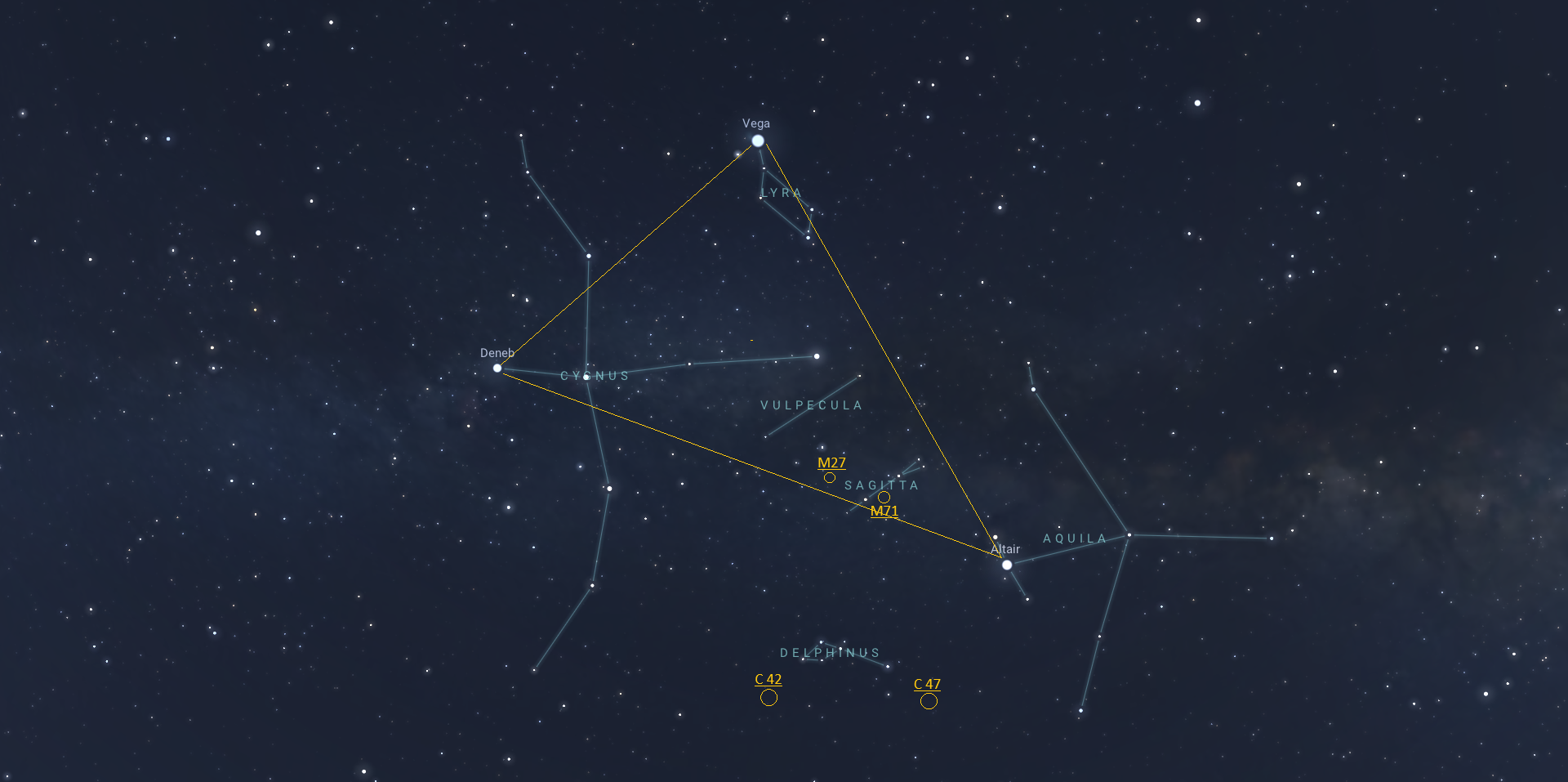
Image: NASA
It is always a great pleasure to meet a reader of the newspaper out and about, especially when they mention something related to stargazing. Thanks to the area newspaper folks who let me share the night sky with you and alert you to upcoming opportunities to join a star party. When you attend one of the events the STARS provide it is especially gratifying to meet people who remember many years ago events.
On September 19th between 7:00 PM and 9:00 PM you are invited to join in the International Observe the Moon Night with a group of ‘lunatics’ of the South Texas Astronomical Society at the Brownsville Southmost Branch Library. Several telescopes will be available for you to get a feel for the different kinds in case you may be hearing the sigh of I wish I had a telescope coming from someone near and dear to you. STARS members will be on hand guiding visitors around the night sky and sharing lunar myths, with activities appealing to students. Joining new faces while observing the current phase (First Quarter) of our satellite neighbor would be a fine and free way to spend an evening. When the Moon is in the fractional phases it is especially intriguing to examine the various craters along the terminator (not Arnold) which is the point where light and shadow merge. You might even try your hand at photography.
The sky may be clear enough to enjoy the geometry of the Great Square of Pegasus, the Summer Triangle, and perhaps even the oddly shaped constellation Boötes in the west. A bonus MAY be a glimpse of Saturn in the east as it rises higher into our field of view and Venus ever lower in the west to move between Earth and the Sun, before emerging to be the Morning Star. A special treat is that Venus will be at its peak brightness that night.
The brightest stars in the Summer Triangle are Vega, Deneb, and Altair. Almost in a straight line from Deneb is the ‘nostril’ of the Swan, Alberio. If the sky is clear and the telescope owner will be able to focus on it you will see that it is actually two stars. Astronomers are not certain in they orbit one another or are just in the line of sight. One is yellow, the other is blue. Although the stars appear small, they are all larger than the Sun. If Deneb were where the Sun is its orbit would engulf Mercury and Venus and almost take in Earth.
Other constellations that will be on the possible to view schedule will be tiny Delphinus, the Dolphin, so popular to ancient sculptors, the Teapot asterism in Sagittarius, and massive Ophiuchus, the first physician, still holding the serpent he cut in half. There is a good story about that constellation. I have mentioned it in earlier columns so I won’t repeat it here. When he killed the serpent, another one emerged from the garden with an herb in its mouth. When the herb was placed in the mouth of the first serpent, the two halves grew back together. There is far more than that to the story-the ancient Greeks and Romans were quite skilled story-tellers; you just might want to visit your local library for a book of their myths.
These are just a few of the constellations from east-south-west. In the north the circumpolar always around constellations include Ursa Minor (Little Dipper asterism). The larger Ursa Major will be only partially seen at our latitude. Perhaps the handle (of the Dipper asterism) will be visible, but not much else at this time of the year. As compensation the inverted house of King Cepheus will be above and a bit east of the North Star, Polaris, with Draco the dragon winding in between the constellations Hercules and Boötes, and Polaris. Queen Cassiopeia, a large W, will be found just east of her spouse, Cepheus.
Whether stars will be out or not, the STARS will be on hand to share astronomy the 19th unless it is pouring rain. Plan on joining the fun, and KLU.
